Barbarosa (1982)
“Find this Barbarosa, and kill him — kill him for me; kill him for yourself; kill him for your family as sworn.”
“Why don’t we just take a walk and we’ll just talk about the Wild West and how to get the hell out of it?”
|
Synopsis: |
|
Genres, Themes, Actors, and Directors:
Review: Nicholson is a fine foil for Brando, and is given a lovely, unexpected romance with Braxton’s conflicted daughter (Kathleen Lloyd). The rest of the supporting cast is excellent as well — including Harry Dean Stanton as Nicholson’s right hand man: … Katherine Lloyd as Nicholson’s love interest: … and Frederic Forrest as Cary, who meets an especially undignified death. While it’s not must-see viewing, it’s well worth a look by western fans or fans of the stars. Notable Performances, Qualities, and Moments:
Must See? Links: |
“We’re all gonna do wonderful things — and if anyone disagrees, they can leave.”
|
Synopsis: |
|
Genres, Themes, Actors, and Directors:
Response to Peary’s Review: … and adds, “In the America we see [here], everyone’s life has epic proportions: hopes and dreams result in bitter disappointment, but sadness and pain are tempered by rewarding friendships; throughout, one’s love for America never dissipates.” (Wasson’s character is obsessed with the national anthem.) Peary argues that although “Arthur Penn’s film has the makings of a masterpiece” (I disagree), it isn’t: “while it contains many lovely moments and devastating scenes, a few important sequences fail” and “although they are talented, you don’t really care if Wasson and Thelen get together”; he rightfully points out that “Thelen’s characterization is more annoying than captivating.” Peary ends his review by noting the “excellent” (I disagree) “autobiographical script by Steve Tesich, who won an Oscar for Breaking Away (1979).” He asserts that this flick is “better the second time around” — but I won’t be giving it another whirl. Unfortunately, this movie is a frustrating disappointment: not only do we not care about the protagonists, but the script is poorly written, inserting new characters and scenarios at random with an assumption we’ll simply understand who they are and how they fit into the arc. We get it that pretty Georgia (whose name we will never, ever forget given that “Georgia On My Mind” is played repeatedly) is bewitching to these three men, who all want a chance to be with her in one way or another — that’s boring, but makes sense as a theme. However, things take a seriously off-kilter turn when Danilo (Wasson) falls in love with the sister (Julia Murray) of his disabled friend Louie (Reed Birney) and visits her palatial home, only to quickly learn that DEEP dysfunction lurks therein. An ensuing scene of “epic proportions”, featuring Murray and Birney’s father (James Leo Herlihy), seems to belong in another Arthur Penn movie altogether. Poor Lois Smith — in a tiny role as Wasson’s new mother-in-law — has an awkward monologue shortly thereafter: … at which point we shift to seeing how Wasson, Thelan, Huddleston, and Metzler make their way through the remaining years of counter-cultural unrest (Metzler goes to Vietnam) and experimentation (Thelan becomes a hippie-ish single mom, marrying Huddleston while pregnant with Metzler’s baby, and roaming on her own through some kind of punk concert at one point). Meanwhile, the ongoing topic of Danilo seeking approval from his abusive immigrant father: … instantly hearkens back to the similar narrative thread in Tesich’s much better Breaking Away, which it seems was his one-hit wonder. While boasting impressive directorial credentials, this one isn’t must-see except for diehard Penn fans. Notable Performances, Qualities, and Moments: Must See? Links: |
“Her whole life is gone. She can never get it back, and you’re living real good; that ain’t right.”
|
Synopsis: |
|
Genres, Themes, Actors, and Directors:
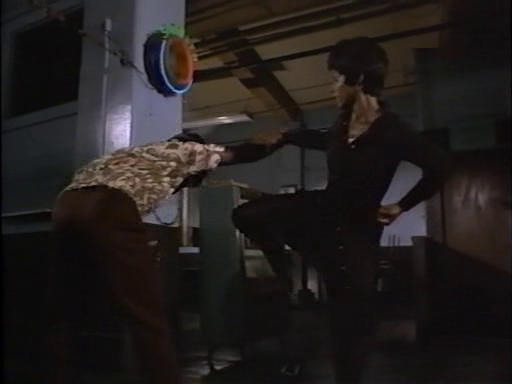
Review: … expecting sex in exchange for drugs, only to be killed off by Coffy in a furious rage. From there, we see Coffy attempting to do her official work at a hospital, but being too traumatized to focus: … given she is deeply concerned about her sister, who is in a rehab center for drug use. Throughout the remainder of the film, we see Greer inhabiting a variety of clever guises to continue her vengeance. She visits a scarred prostitute (Carol Lawson): … and uses violence to convince her to share details of where notorious pimp King George (Robert DoQui) hides his drug stash, then easily infiltrates George’s stallion as a new hire: … though she’s instantly disliked by George’s top girl (Linda Haynes). Coffy is soon kidnapped by a sociopathic john (Allan Arbus) who’s taken a liking to her: … and the jam-packed plot continues to thicken, including more revealed about the aspiring politician (Booker Bradshaw) Coffy is in love with. In its low-budget, high-sensation way, Coffy effectively conveys the complexities of corrupt systems in which everyone is out for themselves, and innocent participants will most definitely be sacrificed; in a world like this, it’s obvious that we need dedicated, savvy vigilantes just like Coffy. Notable Performances, Qualities, and Moments: Must See? Categories
Links: |
“That kid don’t fight right. He fights foreign.”
|
Synopsis: |
|
Genres, Themes, Actors, and Directors:
Review:
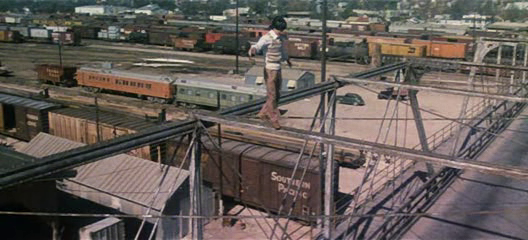
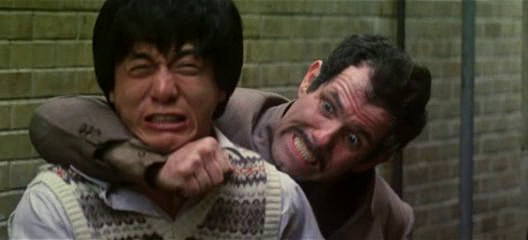
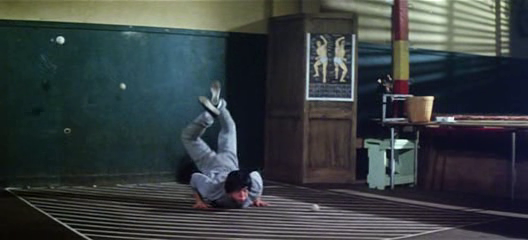
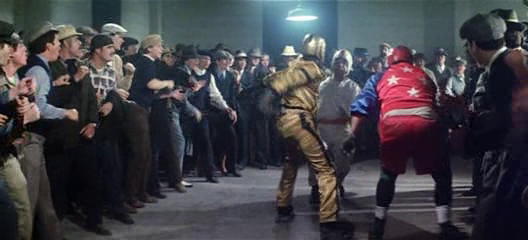
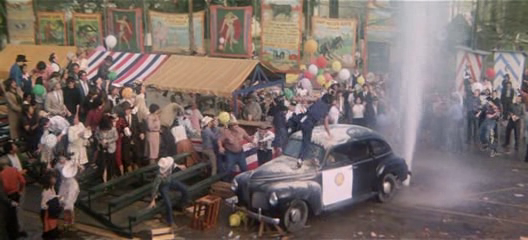
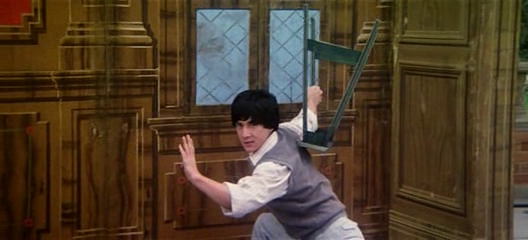
Film fanatics of today — living in the 2020s with access to nearly everything — have so much more to choose from, and clearly, we all should see at least one Jackie Chan movie (though which one, I’m still not positive). Regarding this earlier film, Chan acquits himself masterfully, and it’s actually a little puzzling as to why it didn’t have more of an impact at the time. The comparisons with Bruce Lee are obvious, but he also possesses a clown-like quality that is quite endearing. It’s also refreshing to see him in an inter-racial relationship with Kristine DeBell, who is his number one fan and supporter: … in addition to his uncle (Mako), who is his trainer. From Chan’s initial acrobatics high up above the city in some scaffolding: … to his first fight in an alley outside his father’s shop (when he alternates between offensive moves and pretending to be hurt): … to seeing him training for ultimate dexterity with his uncle: … it’s incredibly clear how much talent and stamina this man has. Meanwhile, his participation in a lengthy roller skate obstacle race (which also involves landing on mattresses and being hosed down by fierce water spigots): … had me wondering anew about the infinite creativity of competitive money-making ventures during the Depression (though who knows how realistic this is). The culminating fight sequence on the streets of Texas is also noteworthy for its carnival-like atmosphere and some genuine tension between Chan and his much bulkier competitors. Note: The film is clearly set precisely in 1930, given that we see a movie poster for Morocco (1930) on the theater Chan enters into near the end. Notable Performances, Qualities, and Moments: Must See? Links: |
“Let’s fix his cavities.”
|
Synopsis: |
|
Genres, Themes, Actors, and Directors:
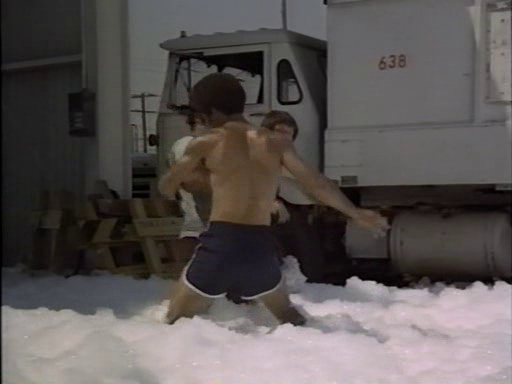
Review: … albeit it with far too many punches to the groin (though I’m guessing audiences were fine with that). The entire affair ends with a massive fight-out in a car wash, leading to very sudsy adversaries. Gloria Hendry — perhaps best known to film fanatics for her role in Live and Let Die (1973) — is a fine and feisty female companion for Kelly, who doesn’t seem to exude much on-screen charisma other than through his fighting. See below for my favorite scene between the two of them (involving a request to do the dishes). Notable Performances, Qualities, and Moments:
Must See? Links: |
“Have you forgotten what Teacher always said? Think of the school, not of yourself.”
|
Synopsis: |
|
Genres, Themes, Actors, and Directors:
Response to Peary’s Review: Peary adds that while the “film has awful dubbing”, “who cares?” given that “there is non-stop action, and watching the remarkable Lee in beautifully choreographed fight sequences (that make intelligent use of close-ups and slow motion) is a unique, exhilarating experience. As always, he is graceful, athletic, charismatic, and in control” while also displaying true “ferocity and anger during his fights” against the “bigoted Japanese.” In terms of this film’s title, according to Wikipedia:
(Whew!) Thank you, Wikipedia! The titles of these ’70s kung fu flicks is undeniably confusing, but fans always rally to the cause. Note: The film’s final shot seems unambiguously inspired by the last shot in Butch Cassidy and the Sundance Kid (1969) (though who knows). Notable Performances, Qualities, and Moments:
Must See? Links: |
“He’s our son: no matter what happens, he’s our son.”
|
Synopsis: |
|
Genres, Themes, Actors, and Directors:
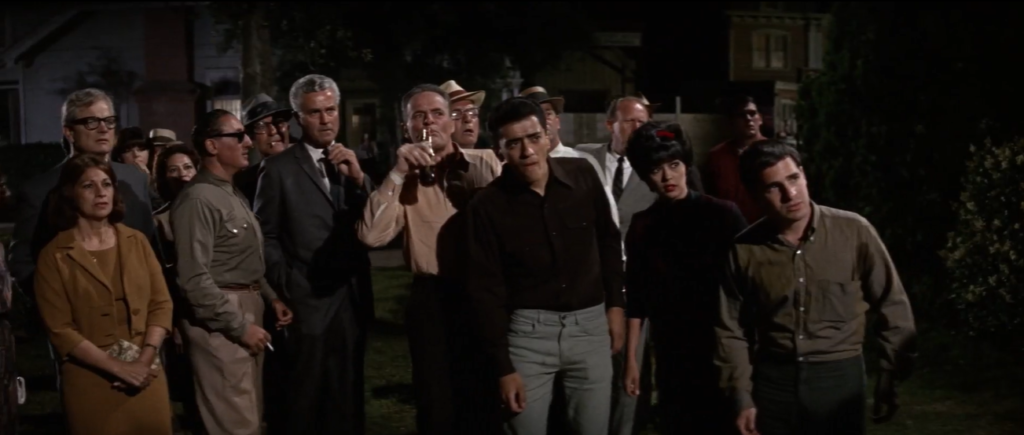
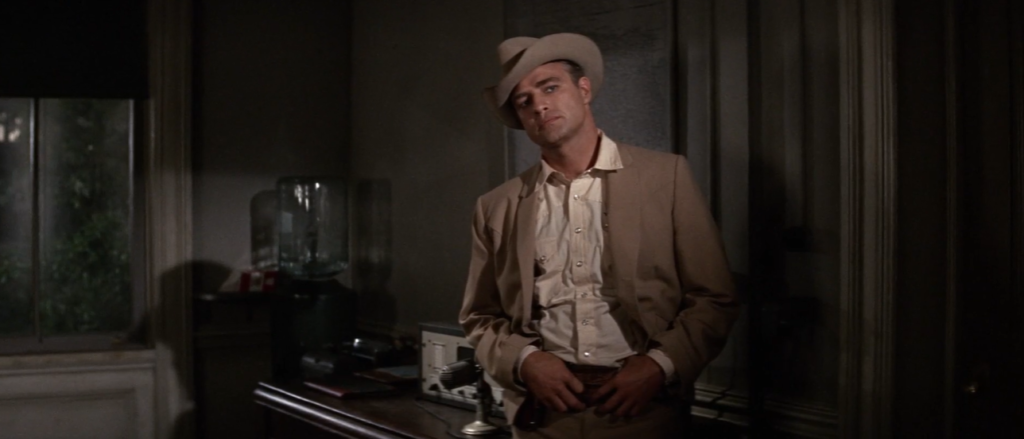
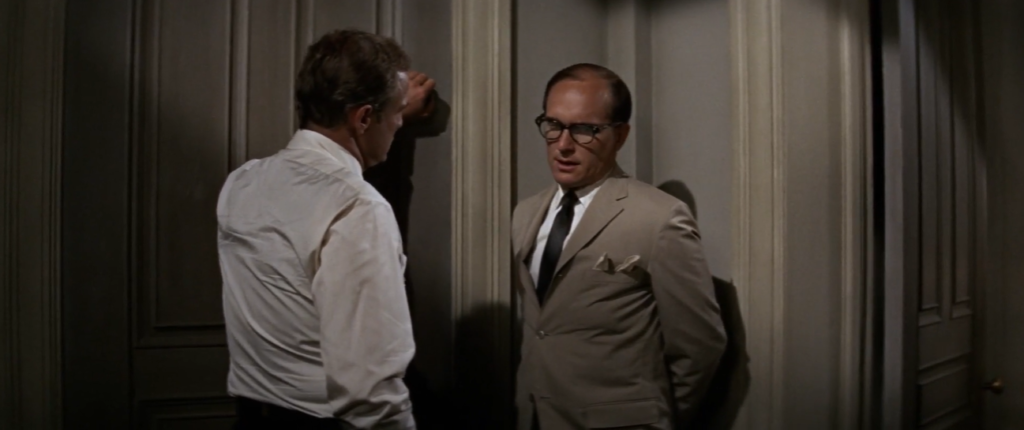
Response to Peary’s Review: Among the motley cast we see “lawmen, lawbreakers, escaped prisoners; whites and blacks; rich, middle-class, and poor; faithful and unfaithful women; old people and youths (who have learned decadence and violence from the adults in town); [and] the decent and the corrupted.” Peary points out that the “picture starts out… slowly,” with “three dull parties going on simultaneously, meant to show how the town is divided according to wealth and age.” (Actually, the first party doesn’t begin until 36 minutes in, and the next two at around 50 minutes.) However, he asserts that the picture “becomes extremely exciting as the violence escalates scene by scene.” He points out as “truly powerful” (not to mention notoriously violent) the “scene in which Brando is beaten up by three ‘citizens’;” his bloodied face reminds one instantly of Terry Malloy in On the Waterfront (1954). Peary notes that the “picture has strong characters and many interesting relationships, including that between Redford, Fonda, and… Fox”: … and he points out that among the vast cast are “Angie Dickinson (who’s at her best as Brando’s wife)”: … “E.G. Marshall (as Fox’s father, the rich man who runs the town)”: … and “Miriam Hopkins (as Redford’s batty, stingy mother.” Unfortunately, there is simply too much going on in this overcooked film, which was handled by too many screenwriters (neither Hellman nor Foote were happy), and purportedly didn’t reflect Penn’s vision, either (he wasn’t involved in editing at all, given producer Sal Spiegel’s heavy-handed approach). A subplot about a Black man (Joel Fluellen) being threatened and then imprisoned for his own safety is barely given any attention: … instead simply adding to the overall tapestry of the town. By the end, when literal flames have erupted (thanks to reckless townsfolk), we appropriately despair for the state of humanity as reflected here. Note: Interested viewers can read more about this movie in chapter 2 of Fiasco: A History of Hollywood’s Iconic Flops (2006) by James R. Parish, available through the Internet Archive. Yay for open access! For the record, other GFTFF-listed titles discussed in this book (which I have yet to read in full) include Cleopatra (1963), Popeye (1980), and The Cotton Club (1984). Notable Performances, Qualities, and Moments:
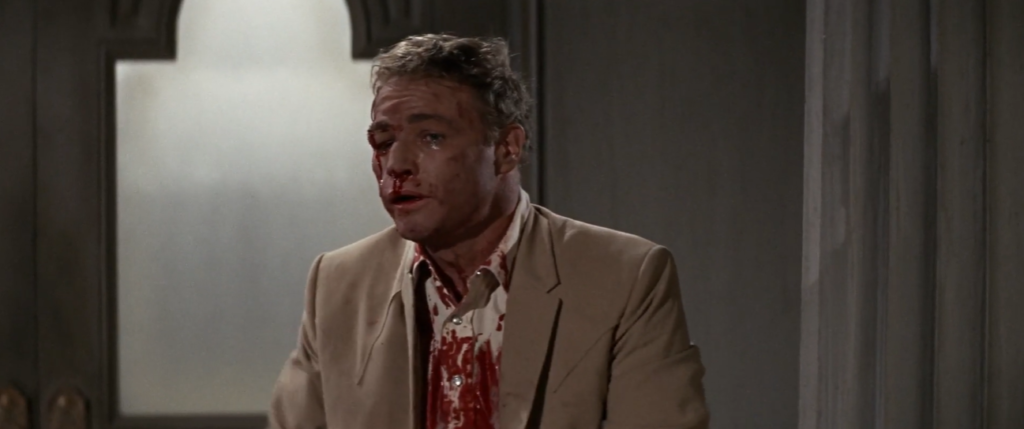
Must See? Links: |
“Who are those guys?”
|
Synopsis: |
|
Genres, Themes, Actors, and Directors:
Response to Peary’s Review: … and “we think this will be a delightful pair to watch as they undertake several adventures.” However, he argues that “what happens is simply that writer William Goldman and director George Roy Hill repeatedly place the duo in danger and have them react in the same exact manner.” He asserts “there is no real story… just constant references… to a posse on their trail” — and while “we had figured that their glib humor was just a part of their personalities and we [simply needed to] wait for the characters to reveal depth,” this never happens; instead, “it turns out to be the trait that dominates all others.” I’m in agreement with Peary’s assessment. Less than halfway through this film, I realized that the remainder of the storyline would simply consist of watching our protagonists attempting to escape their fate, which we know in advance (this film has one of the single most famous closing shots in cinematic history, so I’m not spoiling anything here). Sure, Butch and Sundance made their bed (having plenty of fun doing so), and then had to lie on it — but why should viewers be asked to watch so much of their downfall? I suppose the primary point of this ultimate buddy adventure flick is to see how closely they stuck together through it all — but I found it depressing. With that said, it was nonetheless interesting and informative to listen to a featurette about the making of the film, in which George Roy Hill talks us through his experiences and decisions scene by scene; it’s highly recommended for anyone wanting an insider’s look into this movie, which was expertly crafted on every front. Notable Performances, Qualities, and Moments:
Must See? Categories
(Listed in 1001 Movies You Must See Before You Die) Links: |
“Little Man was small — but his bravery was big.”
|
Synopsis: |
|
Genres, Themes, Actors, and Directors:
Response to Peary’s Review: Peary argues that “While not everything Crabbe tells us is [necessarily] true, the gist of the story, about Custer and the Indians, is true. Through the horrifying scenes of the cavalry massacring Indians, Penn and Willingham obviously were trying to draw parallels to the systematic genocide being carried out by equally arrogant American soldiers on yellow-skinned villagers in Vietnam” — thus making this “a political film about the chauvanism and brutality of white American imperialists.” Peary points out that the “portrayal of Indians” in this film “should be commended — it’s so sympathetic and insightful that it allows for some humor about Indians (i.e., Chief Running Nose; the Indian who walks backward).” To that end, I was pleased to see Chris Eyre — director of Smoke Signals (1998), and of Cheyenne and Arapaho descent — introducing this film for the AFI Movie Club as “one of his favorites,” and to know that Chief Dan George was rightfully nominated as Best Supporting Actor (the first Native American to garner this designation). Hoffman’s performance, meanwhile — Peary nominates him as one of the Best Actors of the Year in his Alternate Oscars — is truly impressive; this role exhausted him to the point that he took up cigarettes again after an 8-month hiatus. Also noteworthy is Mulligan’s “bravura” portrayal as “monstrous, conceited, insane General Custer”. While I’m not a fan of all the film’s humor: … I can understand its inclusion, and it all comes across as part of the wacky panorama of Penn’s attempt to subvert the genre. This unsung western remains well worth a look. Notable Performances, Qualities, and Moments:
Must See? Categories
(Listed in 1001 Movies You Must See Before You Die) Links: |