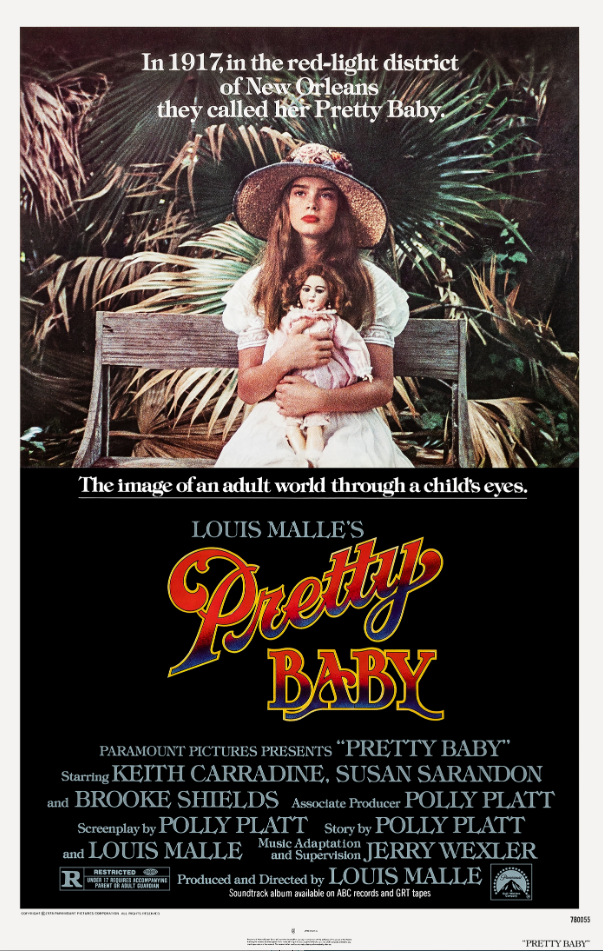
Pretty Baby (1978)
“I run a good old-fashioned whore house, monsieur.”
|
Synopsis: |
|
Genres, Themes, Actors, and Directors:
Response to Peary’s Review:
He adds that while it’s possible “the real Violet (whose story is told in Al Rose’s nonfiction work Storyville, New Orleans) didn’t consider herself victimized when a child” (and neither does Shields herself, for having been allowed to play the role), it was nonetheless “irresponsible on Malle’s part to use her as his central character” and ignore “countless other ex-child prostitutes’… tales of horror.” He writes, “The sledgehammer ‘selling of Brooke Shields as pubescent sex symbol,’ which gained momentum because of this film, was truly tasteless” and these days wouldn’t be tolerated for a second; as DVD Savant writes in his review:
Exactly. Be forewarned. Meanwhile, Peary writes that “Shields gives the one impressive performance in the film”:
… but “Sarandon’s role is too brief”:
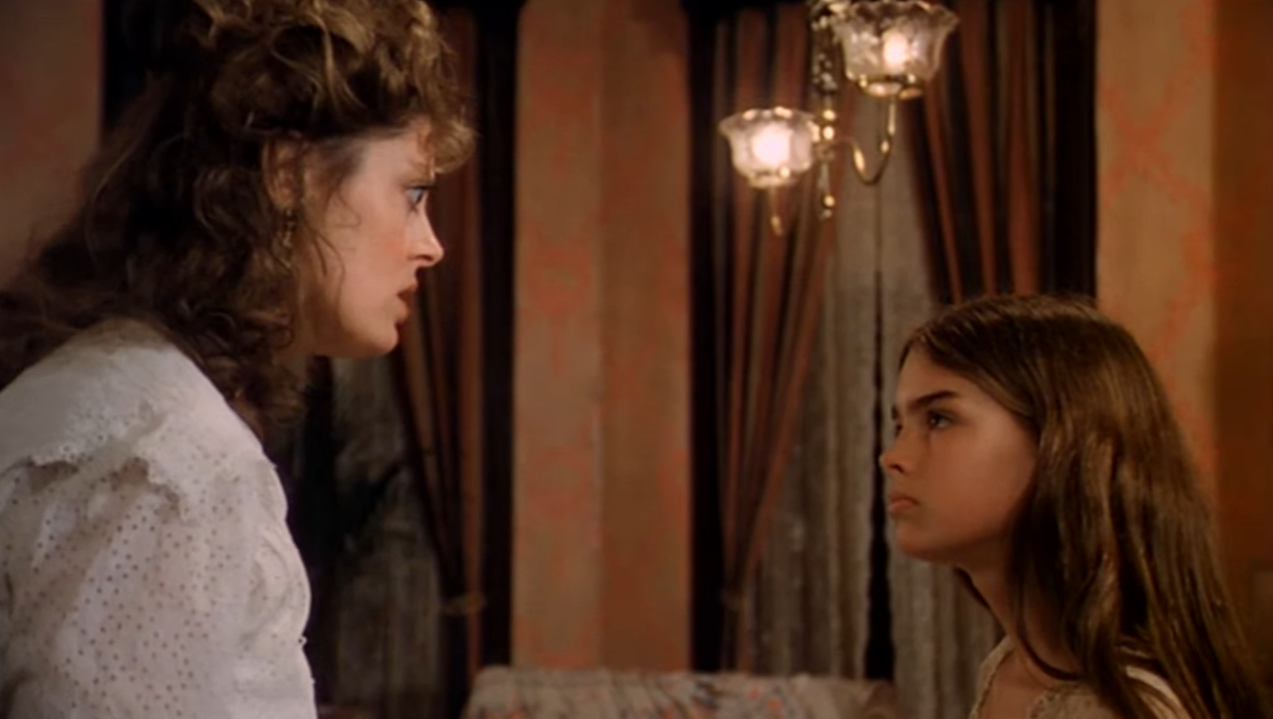
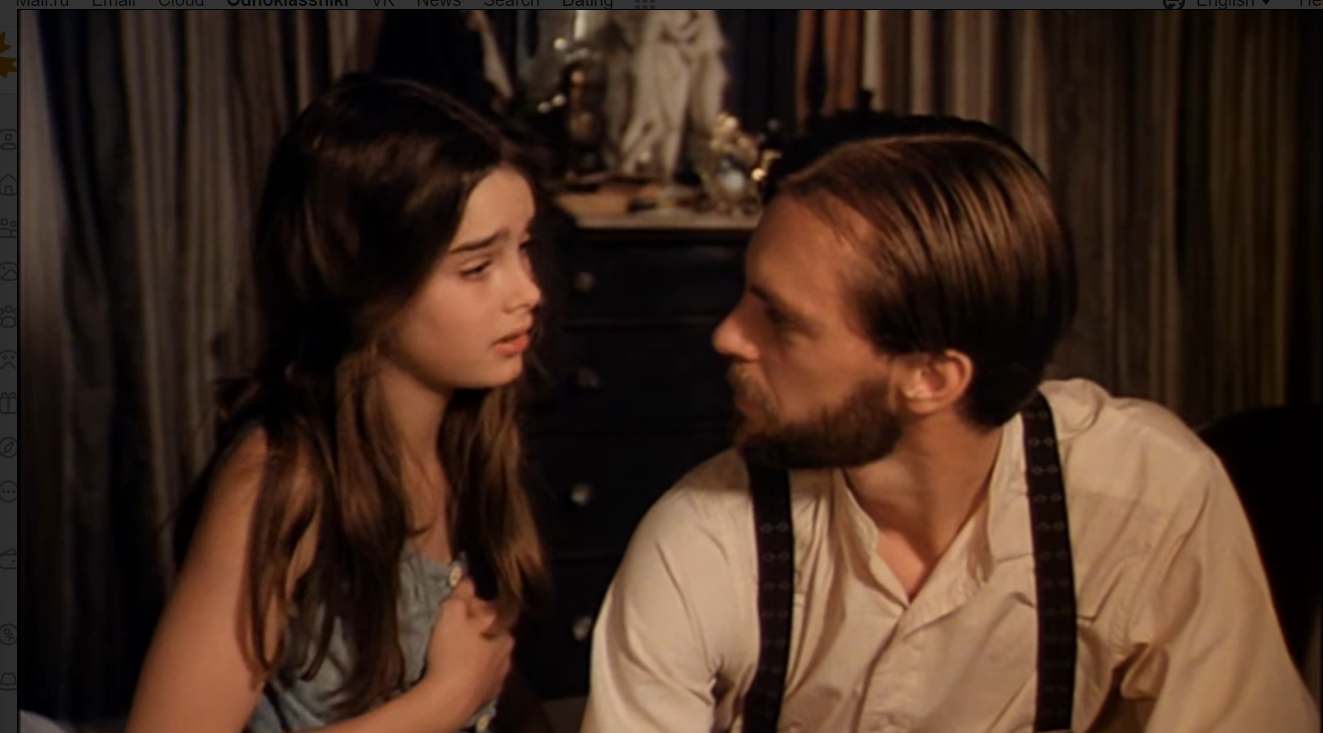
… “Carradine is badly miscast” (not to mention his character being poorly developed):
… “and Faye is so atrocious” (I disagree) “that if she mangled the word monsieur one more time, [he’s] sure someone in the crew would have strangled her.”
He adds that the “picture’s one strong suit is its look,” noting that “visually, the film is an homage to the impressionists of the era — just as the music is a tribute to the jazz greats of the period, like Jelly Roll Morton” (played as a slightly different but comparable character by Antonio Fargas).
Despite Shields’s easy friendship with Fargas, racial tensions of the era are present and toxic in the film, with Black characters mostly relegated to poorly treated servant or mystical roles and given little to no agency or voice. One potent scene shows that Shields flirting with a young Black boy merits her a whipping because of his skin color — not because they’re too young for this type of sexualized interaction. Back to the film’s look, “each shot is beautifully composed, and the frame becomes a mixture of muted colors, natural light, and shadows.”
Indeed, “as long as Malle and cinematographer Sven Nykvist concentrate on visuals, things run smoothly” — but “when characters speak Polly Platt’s dialogue, we are bombarded with the cliches we’ve heard in every other bad movie set in a brothel.” In his essay for Cult Movies 2, Peary elaborates on his disappointment with Malle for his overall (mis)handling of this film. Peary asserts that “Louis Malle is the classic voyeur among filmmakers,” with a “detached style” in which “the artist stands back from his subject” and “merely observes his characters going about their business within his created, or recreated worlds, rather than becoming involved in their lives and making judgments about them.” When it comes to a film about such a vile topic as under-aged prostitution, however, Malle’s approach of taking “a steamy, sensational subject and [striving] for artistry instead of controversy” simply doesn’t fly.
Peary asserts that he sees “less objectivity than passivity, too much artistic pretentiousness, and, worse, the lack of necessary conflicts because Malle doesn’t want to choose sides.” But should we really not feel judgmental when watching Shields paraded out on a pallet for auction to the highest bidder? This scene is beyond disturbing, rightfully so.
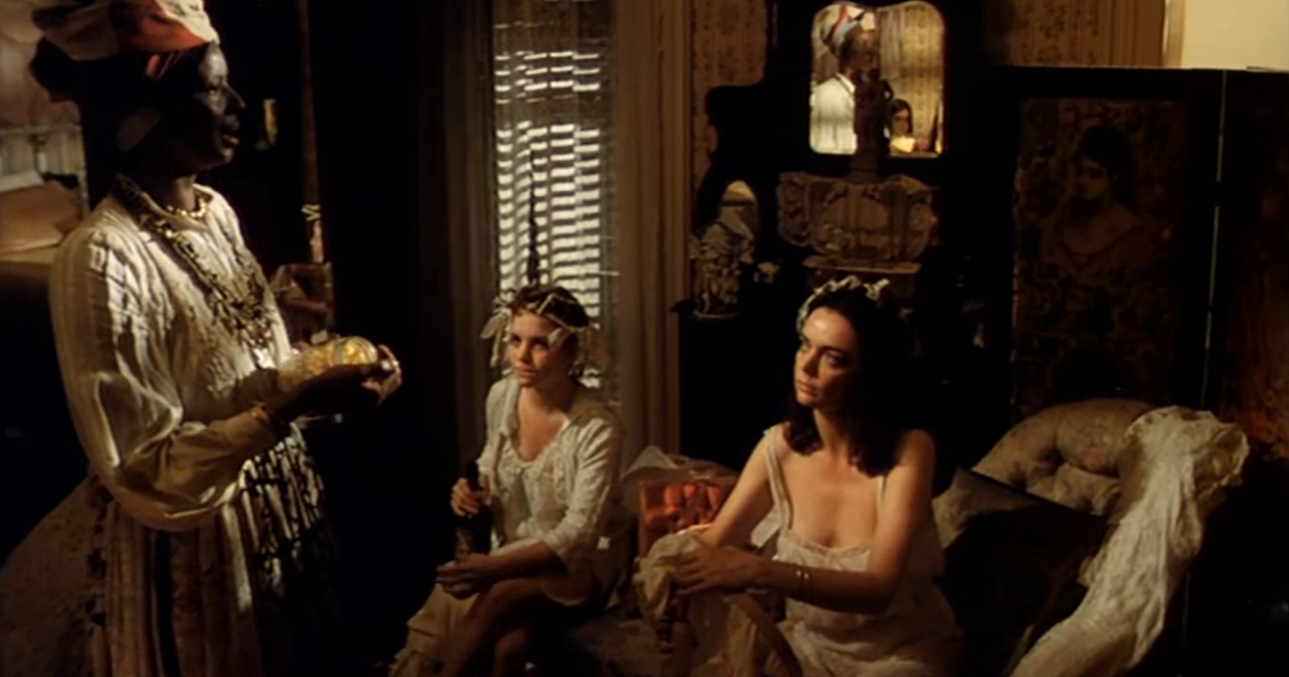
Perhaps worst of all is that a film this beautifully shot — on such a contentious but important historical topic — is so badly written, especially in the second half: it’s not “worth” the controversy or effort made to get past one’s disgust. Despite all my deep reservations, however, I think film fanatics should give this film a once-look simply to be familiar with its historical infamy. With that said, I don’t understand why it’s included as a cult movie; did people really go to see this again and again? And if so… that feels especially exploitative. Note: Watch for Barbara Steele and Diana Scarwid as two of the prostitutes, the former seeming realistic and the latter giving an atrocious performance with a German accent. Notable Performances, Qualities, and Moments:
Must See? Categories
Links: |