|
Genres, Themes, Actors, and Directors:
- Friendship
- Jane Russell Films
- Outlaws
- Rivalry
- Thomas Mitchell Films
- Walter Huston Films
- Westerns
Response to Peary’s Review:
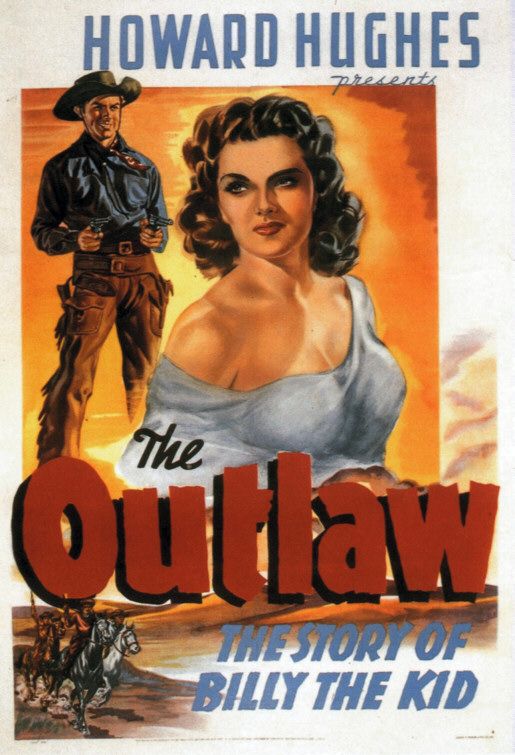
Peary writes that this “‘notorious’ adult western” by “director-producer Howard Hughes” was “held back because of censorship problems due to newcomer Jane Russell’s sexually uninhibited performance” — which is exactly what business-savvy Hughes and his publicist Russell Birdwell were hoping for. As noted in TCM’s review:
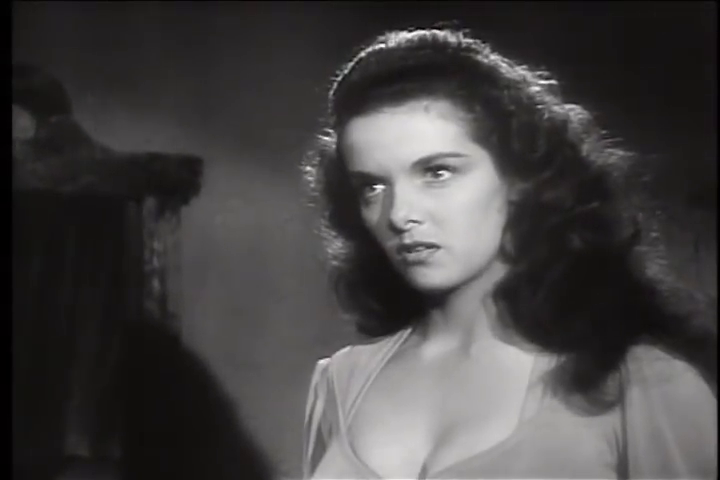
As soon as production began, The Hayes Office, charged with upholding the moral fiber of motion pictures, demanded a copy of the script for review. After reading it, The Hayes Office demanded several changes to what it considered “racy dialogue and situations,” and cautioned Hughes to “avoid sexual suggestiveness.” But Hughes had no intention of pouring water on his smoldering screenplay, and when the picture was finally released, Hughes got exactly what he expected. Censors objected not only to Russell’s low-cut blouse, but also the treatment of her character as merely a sex object.
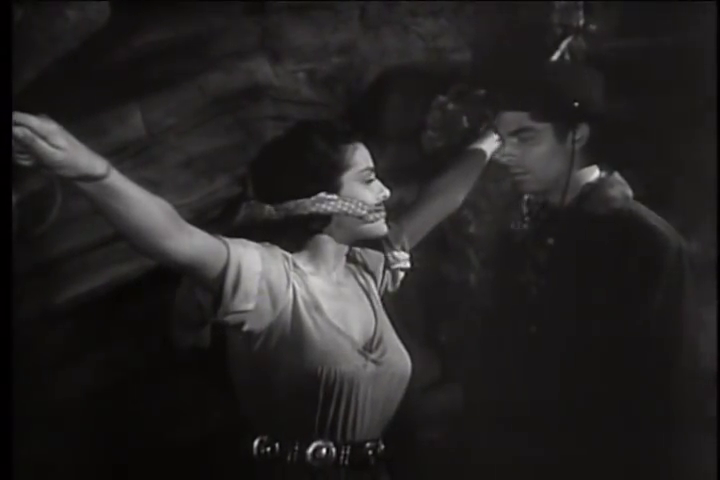
Ironically, while the film does place ample emphasis on Russell’s photogenic bosom, the film is less focused on sexual dynamics between Russell and her two lovers than on, as Robert Lang notes in his book Masculine Interests: Homoerotics in Hollywood Films:
… the complications that arise when Doc Holliday (Walter Huston) falls in love with Billy the Kid (Jack Beutel) and Pat Garrett (Thomas Mitchell) becomes jealous of the bond that develops between the two men… [The] proper locus of the film’s sexuality is not embodied in Jane Russell as Rio MacDonald, but is played out in the relationship between the two men (and their horse).
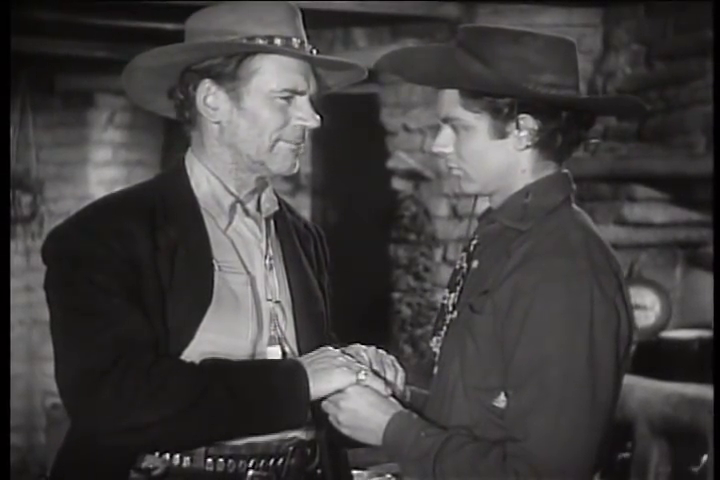
Regardless of whether one reads the relationship between Huston and Beutel as sexual or not, it’s undeniable that the real “love triangle” here is between these men (who take an instant liking to one another, for no discernable reason) and Mitchell. In his review, however, Peary simply points out that “after a while there’s too much male talk and not enough about Russell”, adding that it’s “hard to believe” the “very pretty, buxom, teenage girl in the tight, revealing dresses” is “the same actress who’d confidently sing, dance, and be funny with Marilyn Monroe ten years later in Gentlemen Prefer Blondes (1953).”
The film itself, unfortunately, is a tonally inconsistent chore to sit through. Peary writes that the “comedy and music are intrusive”, but this is an understatement: Victor Young’s score is atrociously inappropriate for the melodramatic material, which doesn’t work as a comedy. Meanwhile, the film is at least half an hour too long, and Hughes didn’t know how to elicit strong performance from his leads. While the reasons for Beutel’s limited career are contested, it seems clear to me that he was more of a pretty face than a talented actor; as noted previously, it’s challenging to understand why Huston feels such loyalty for him.
Redeeming Qualities and Moments:
- Gregg Toland’s cinematography

Must See?
No, though film fanatics will be curious to give it a once-through given its historical notoriety.
Links:
|