|
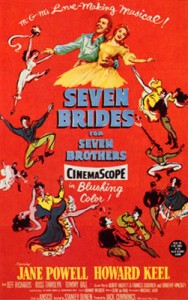
Synopsis:
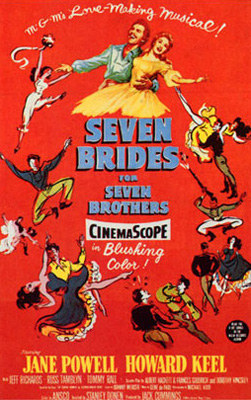
In 1850s Oregon, a woodsman (Howard Keel) comes to town to find a wife (Jane Powell), who he brings back to the cabin he shares with his six rough-and-tumble brothers (Jeff Richards, Russ Tamblyn, Tommy Rall, Marc Platt, Matt Mattox, and Jacques d’Ambois). Soon the brothers decide they want to be married, too, and take extreme measures to achieve this goal.
|
|
Genres, Themes, Actors, and Directors:
- Battle-of-the-Sexes
- Howard Keel Films
- Jane Powell Films
- Kidnapping
- Musicals
- Russ Tamblyn Films
- Stanley Donen Films
Response to Peary’s Review:
When I first saw this “joyful, colorful” Technicolor musical as a teenage film fanatic, I recall finding its very premise (in which “lovesick brothers kidnap the town girls they desire and bring them home”) so distasteful that I failed to see how it could have any kind of a fan-base at all. Therefore, upon a recent revisit, I was pleasantly surprised to find myself largely in agreement with Peary’s positive review, in which he refers to it as “a lot of fun”, calling it a “rare musical that even young boys will love”, given that “Keel is handsome and masculine enough to get away with love songs” and “the dancers are extremely athletic”. He points out that the “score by Johnny Mercer and Gene DePaul has some excellent, catchy songs”, and accurately notes that “the Michael Kidd-choreographed dances” — performed by a team of “marvelous dancers” (many professionals) — are “terrific”, calling out “the exuberant, spectacular ‘barn-raising’ number” as the film’s definitive “show-stopper”.
Rewatching the film recently, I was gratified to find that the seemingly distasteful storyline — “based on Stephen Vincent Benet’s ‘The Sobbin’ Women'”, which in turn “was inspired by Plutarch’s ‘The Rape of the Sabine Women'” — actually possesses a relatively strong feminist strain. Spunky Powell’s foolhardy willingness to marry Keel the day she meets him (and to wax rhapsodic in song about her desire to cook and clean for him) is tempered by her savvy calculation that this is likely her best possible option in life; it’s certainly better than the thankless work as a servant-for-hire she’s been doing until then. Of course, she didn’t bargain on Keel having six lunk-headed brothers who she’d also be expected to cook and clean for — but she quickly asserts her dominance in their household, “playing Snow White” as she attempts “to turn the ruffians into gentlemen”. And, once the film’s infamous kidnapping occurs, she retains her authority, dictating at every moment exactly what will happen next. She’s a refreshingly strong “Western” woman, and this remains one of Powell’s best roles.
Interestingly, Jonathan Rosenbaum — in his review of the film for 1,001 Movies You Must See (2003) — refers to it as “a profoundly sexist” (albeit “eminently hummable”) movie, one which provides a “fascinating glimpse at the kind of patriarchal rape fantasies that were considered good-natured and even ‘cute’ at the time”, with a bevy of tunes that “accurately pinpoint the movie’s sexual politics” (such as “Bless Your Beautiful Hide” and “I’m a Lonesome Polecat”). His take is exactly how I felt as a much younger film fanatic; but at this point, I’m willing to simply place the film within its historical context, and recognize that for women at that time and in that geographical situation, finding a suitable husband really was likely the cleanest path to security and happiness. Regardless, I’m now able to appreciate Seven Brides… for its merits — vibrant widescreen Technicolor cinematography, “hummable” tunes, and truly fantastic dancing — rather than its questionable premise.
Redeeming Qualities and Moments:
- Jane Powell as Milly
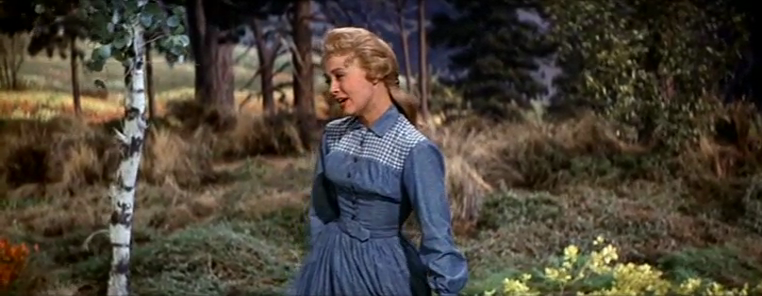
- Many fine dancing sequences
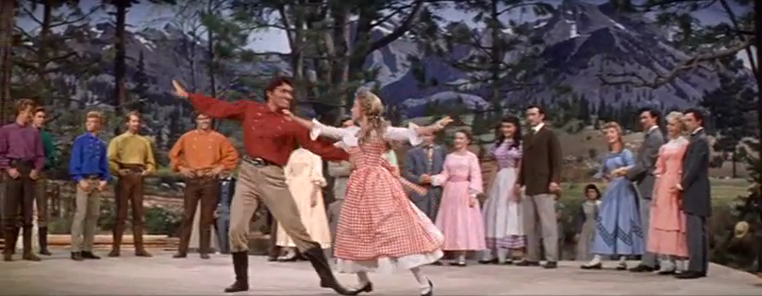
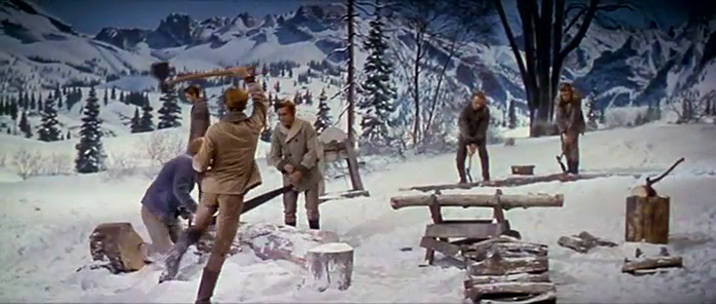
- Vivid cinematography
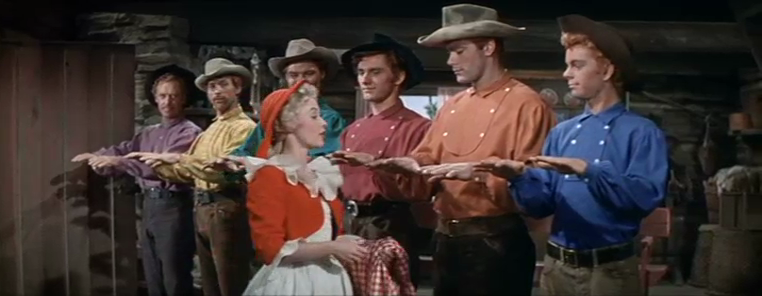
Must See?
Yes, as a classic Hollywood musical. Nominated by Peary as one of the Best Pictures of the Year in his Alternate Oscars.
Categories
- Important Director
- Oscar Winner or Nominee
(Listed in 1001 Movies You Must See Before You Die)
Links:
|