Broken Blossoms (The Yellow Man and the White Girl) (1919)
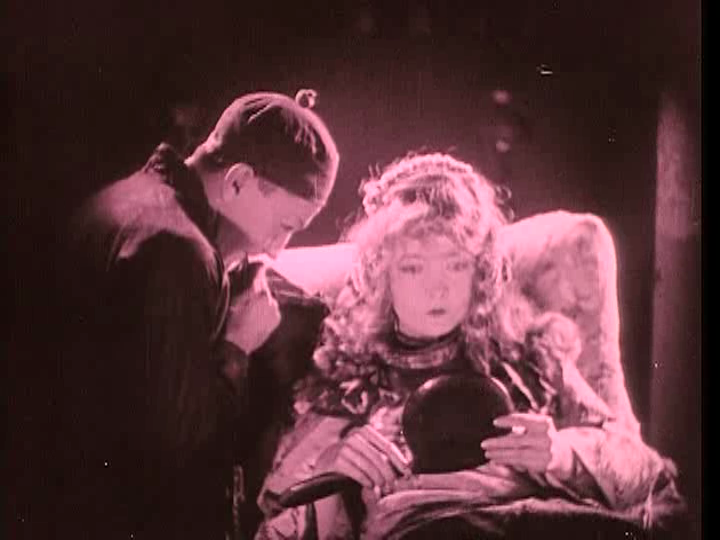
“The Yellow Man watched Lucy often. The beauty which all Limehouse missed smote him to his heart.”
|
Synopsis: |
|
Genres, Themes, Actors, and Directors:
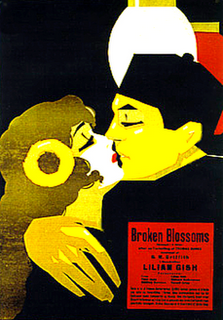
Response to Peary’s Review: The film’s terribly antiquated, casually racist subtitle will likely turn many modern film fanatics off; but once they make tentative peace with both this and the (then standard) casting of white men in both central Asian roles, they’ll likely be pleasantly surprised to find that Griffith — the infamous director of America’s most egregiously racist classic film, Birth of a Nation (1915) — seems to at least be trying to portray the film’s Chinese-American protagonist (Cheng) in a reasonably respectful light. Indeed, it’s gratifying to know that Griffith “considered the main theme of his film to be that Americans wrongly consider themselves superior to foreigners, including the Chinese, who have a noble, peace-loving philosophy”. Cheng is shown at the beginning of the film to be a noble-minded Buddhist missionary hoping to convert European heathens to more peaceful ways — and thus his quick descent into opium addiction after arriving on the sordid shores of London is given a bit of context and justification, rather than simply perpetuating the trope of drug-addled Asians. (Actually, as I think about it, this piece of the narrative could easily have been expanded upon: I’d love to have seen more of Cheng’s travails upon arrival in London.) At any rate, Cheng’s poetically romantic yearnings towards Lucy could be (and are) explained away as merely a platonic desire to love and assist that which is most pure and good in the world — though, again, it would have been much more fulfilling to see this most unusual cinematic couple actually moving towards something “real” together. This would have required a more substantial storyline in general, but at least would have given a shred of credence to the fantastical poster (shown above). In terms of the lead performances, Peary accurately argues that “Crisp overacts”, “Barthelmess under-acts (as if he believed one change of expression would let us know that he isn’t really Oriental after all)” — but Gish “acts up an exciting storm”. He notes that “from her timid talking, stooped, crooked posture, and terrified eyes, Gish immediately gets us to understand that her beatings are a daily thing for her”, and she is “totally convincing” in the role. Her character’s ability to “smile only if she lifts the sides of her mouth her fingers” was apparently thought up by Gish herself, and remains one of the film’s most indelible (recurring) images. * TCM’s article lists Gish as 23-years-old when the film was made, but this doesn’t make mathematical sense, given that IMDb cites 1893 as her birth year. Redeeming Qualities and Moments:
Must See? Categories
(Listed in 1001 Movies You Must See Before You Die) Links: |