Colossus of New York, The (1958)
“It would have been inhuman to deprive the world of his genius!”
|
Synopsis: |
|
Genres, Themes, Actors, and Directors:
Review: Redeeming Qualities and Moments:
Must See? Links: |
“It would have been inhuman to deprive the world of his genius!”
|
Synopsis: |
|
Genres, Themes, Actors, and Directors:
Review: Redeeming Qualities and Moments:
Must See? Links: |
“I know if we ever got mixed up in an Othello kind of thing, it would be — the end.”
|
Synopsis: |
|
Genres, Themes, Actors, and Directors:
Review: I disagree with Peary, and find it challenging to understand how Colman’s “award-guaranteeing scenes as Othello, which critics of the day loved as much as did the audiences in the movie, reveal his limitations as an actor”. While I’m not a fan of snooty theater actors or blindingly possessive husbands, Colman’s conviction and pathos in both roles is compelling. Actors are temperamental creatures (to say the least!), and Colman takes that archetype to the hilt here. Winters, meanwhile, does a stand-out job in her break-through role as Colman’s mistress, and Hasso is poignant as well. Milton Krasner’s cinematography makes the entire shadowy affair a noir-ish treat to watch. Watch for Betsy Blair in an unexpectedly humorous (though poignant) scene as a would-be actress desperate to convince O’Brien she’s right for a real-life part in his investigative sleuthing.
Redeeming Qualities and Moments:
Must See? Categories Links: |
“This is the 20th century — there must be some way of handling an overgrown animal!”
|
Synopsis: |
|
Genres, Themes, Actors, and Directors:
Review: Redeeming Qualities and Moments:
Must See? Categories
Links: |
“Have you ever had diplomatic relations with a woman?”
|
Synopsis: |
|
Genres, Themes, Actors, and Directors:
Review:
Cedric Gibbons and Fredric Hope’s Oscar-winning art direction, and Adrian’s gorgeous gowns (according to TCM, MacDonald’s 24 gowns alone “were so lavish it took 12 seamstresses four months to build them”) make this a treat to watch, and fans of MacDonald won’t want to miss it — but it’s not quite must-see viewing for all film fanatics. I recommend seeing MacDonald in Naughty Marietta (1935) instead. Redeeming Qualities and Moments:
Must See? Links: |
“Doctors and scientists often have some queer things on their mind.”
|
Synopsis: |
|
Genres, Themes, Actors, and Directors:
Response to Peary’s Review: Redeeming Qualities and Moments:
Must See? Links: |
“Just think what you and Miss Breckenridge could do with a dozen Eohippi!”
|
Synopsis: |
|
Genres, Themes, Actors, and Directors:
Review: Redeeming Qualities and Moments:
Must See? Links: |
“We fight for our living and love at our leisure.”
|
Synopsis: |
|
Genres, Themes, Actors, and Directors:
Review:
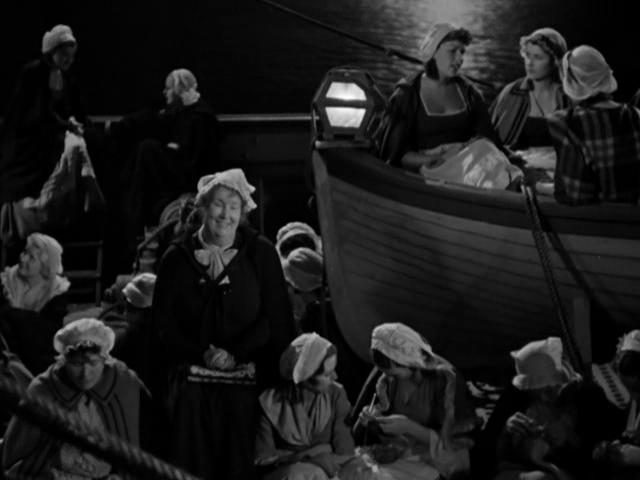
… and she is perfectly happy to fall in love with a mercenary (Eddy) rather than maintaining her status among nobility. She’s also quick-on-her-feet and ingenious — as when she hides from police on the ship by stuffing her mouth with food, and selects a random drunk in the crowds as her “brother” seeing her off; and the scene in which she convinces Morgan she’s been deceptive on her application. She handily staves off unwanted attention from numerous men after fabricating an identity as a “loose woman”, and takes great risks for love near the end of the film. Themes of female strength pervade the film in other ways as well. While the women heading to the colonies are openly viewed as chattel (some are actually pinched and measured for physical strength), they band together collectively, and one gives her life to protect the others from the vicious pirates. Meanwhile, Eddy’s character (unlike the dull Mountie he portrays in Rose-Marie) is charismatic and appealing:
…and many supporting actors give fine, memorable performances: Lanchester is hilariously bitchy as Morgan’s jealous wife, and Morgan uses his spluttering diction to humorous effect.
It makes sense that the screenplay is creative and clever, given that it was written by noted husband-and-wife team Albert Hackett and Frances Goodrich. Redeeming Qualities and Moments:
Must See? Categories
Links: |
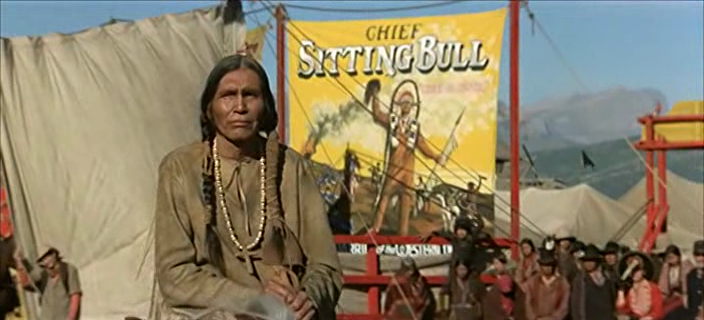
“Sitting Bull says that history is nothing more than disrespect for the dead.”
|
Synopsis: |
|
Genres, Themes, Actors, and Directors:
Review:
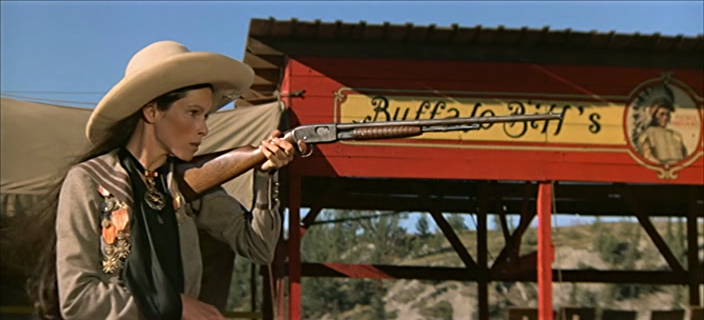
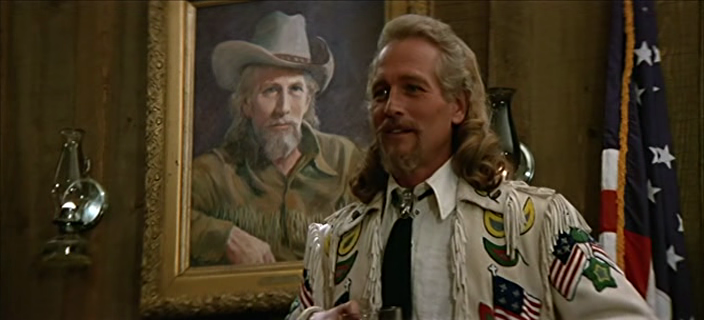
This heartbreaking depiction of our country’s literal silencing of Indians makes its point clearly. I’m also fond of scenes featuring Chaplin as the fiercely talented and self-competitive sharp-shoot Annie Oakley — but other elements of the film are less successful, and Newman’s final soliloquy seems ill-suited at best. Redeeming Qualities and Moments:
Must See? Links: |
“If I should ever call you, would you answer me?”
|
Synopsis: |
|
Genres, Themes, Actors, and Directors:
Review:
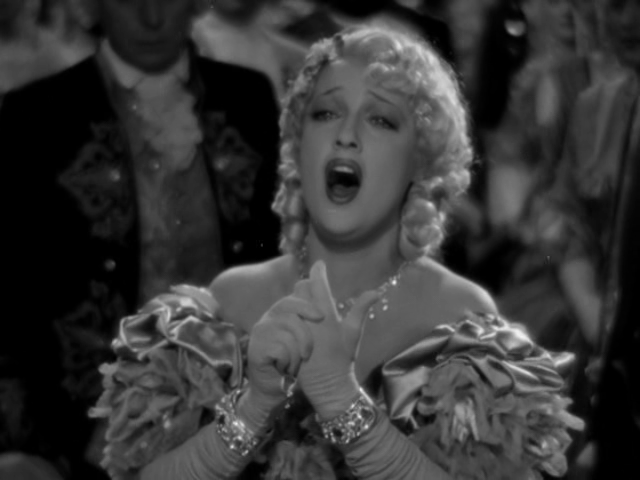
Can you hear it? I’m sure you can. As seemingly interminable as this sequence is, the rest of the film also leaves much to be desired. MacDonald’s diva singer is simply insufferable (though her behavior is presented as acceptable and perhaps even expected), and her blind adoration for a murderous brother (Stewart, in his break-through role) merely lowers one’s opinion of her even further (then again, perhaps filial loyalty was considered such a virtue that this was overlooked).
MacDonald’s romance with stiff-as-cardboard Nelson Eddy is as inconsequential as could be; we’re made to understand that two such compelling operatic voices simply must be together. Film fanatics may be curious to watch this film once, to hear “When I’m calling you…” in its original context — but it otherwise should be relegated to historical vaults. Redeeming Qualities and Moments:
Must See? Links: |
“Savages — brutes — fiends! Why did I ever come to this nightmare of a country?”
|
Synopsis: |
|
Genres, Themes, Actors, and Directors:
Review:
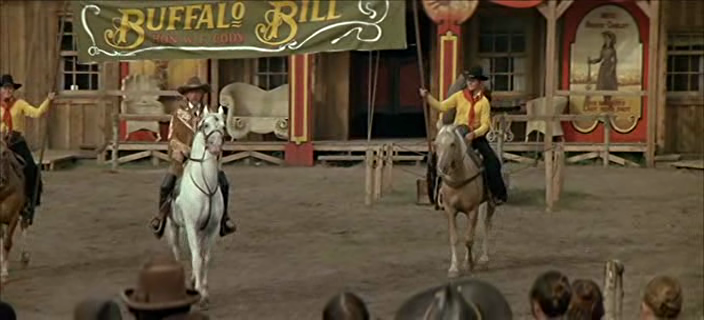
Cody is shown as generally sympathetic and supportive of Indian culture (and concerned about too many bison being slaughtered), but it’s hard to tell fact from fiction, especially given the critical intervention of ultimate storyteller and myth-maker Ned Buntline (Mitchell) into Cody’s life.
The film’s most discomfiting scenes feature Darnell as an Indian princess who is openly jealous of Cody’s crush on O’Hara (thus adding a bit of “love triangle” tension to the film). In one scene, she helps the semi-literate Cody write a response to O’Hara’s note, looking at him with baleful eyes as she repeatedly attempts to craft an appropriate signature on his behalf. Later, she sneaks into O’Hara’s room and tries on a gown:
This scene could be deconstructed in countless ways — but suffice it to say that Darnell’s character is openly ashamed of being Indian, and only believes she can have worth (and Cody’s heart) by looking beautiful in a “white girl’s way”. Meanwhile, the entire romance between McCrea and O’Hara lacks conviction:
We’re not given much insight into why Cody would be so attracted to her other than her beauty, and their ongoing clash in lifestyles (who knew?!) simply serves as a predictable plot element driving narrative tensions forward. Note: Nine years after his supporting role in Annie Oakley (1935) as Buffalo Bill, Moroni Olsen was cast in essentially a cameo role here as the father of the woman Buffalo Bill marries — a nifty touch for those keeping track. Redeeming Qualities and Moments:
Must See? Links: |