|
Genres, Themes, Actors, and Directors:
- Africa
- Cross-Cultural Romance
- Jungles
- Maureen O’Sullivan Films
- Primates
- Tarzan Films
- W.S. Van Dyke Films
Response to Peary’s Review:
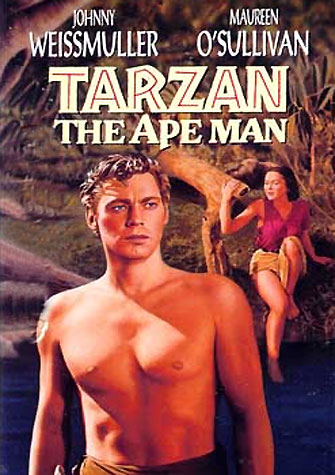
Peary argues that while this “first talkie Tarzan film” has “lots of action and adventure”, it is “foremost a very erotic love story set in the primitive jungle of Africa”, and was “directed with adults in mind by W.S. Van Dyke”. Indeed, much like two other similarly-themed films of the era — Tabu (1931) and Bird of Paradise (1932) — Tarzan, the Ape Man (which “borrows elements from Edgar Rice Burroughs’s first Tarzan novel… and deletes many more”, including “all references to Tarzan’s origins”) offers plenty of provocative pre-Code sensuality, in the form of both 20-year-old O’Sullivan as Jane — a “young woman who seems to be searching for excitement… and her first lover” — and buff Romanian-born “swimming champion Weissmuller”, who Peary argues “has amazing screen presence” despite the fact that he barely speaks a word. The bulk of Peary’s review focuses on an analysis of O’Sullivan’s sexual coming-of-age, as she graduates from “childish frolicking” with Tarzan to the scene in which he “lifts her and, as if she were a bride, carries her up the tree to his lair”, after which point “she acts grown up” — and their tentative romance does dominate the storyline. The climactic ending, however, shifts gears to offer plenty of action and adventure, courtesy of a scary dwarf tribe (!) and “a monster gorilla” which “anticipates King Kong.” It’s all silly but effectively harmless serial fun.
Note: This film was followed by five other Weissmuller/O’Sullivan Tarzan movies made for MGM — all of which (yes, all) are listed in Peary’s book. Stay tuned for my ongoing assessment…
Redeeming Qualities and Moments:
- A provocative pre-Code telling of Edgar Rice Burroughs’ classic adventure novel

Must See?
Yes, simply for its historical importance as the most definitive of all the Tarzan movies.
Categories
Links:
|
One thought on “Tarzan, the Ape Man (1932)”
Like ‘Tarzan and His Mate’, this is a tentative once-must – for those who enjoy this nostalgic kind of adventure story or are fans of the Tarzan stories.
Watching it again, a fair amount of it came back to me (more or less from childhood) – and, overall, I was wrapped up in this first entry more than I was the second one (which many seem to prefer). There’s a nicer built-in build-up (with Jane in new territory as a member of an expedition) and the unfolding of it all engaged me more.
I also love the first time Tarzan and Jane are alone and begin the nearly-impossible task of communicating with language. Though it’s not a moment that’s meant to be funny (I don’t think), Tarzan keeps nudging Jane, then pointing to himself – back and forth, back and forth – saying both their names with each body prod until Jane is forced to cry out, “Oh, please *stop*!” (…Makes me chuckle.)
As for the level of excitement, I would think this film has about as much of that as its sequel entry; and there appears to be virtually no difference in tone between films.