Jesus Christ Superstar (1973)
“Why should I die — oh, why should I die?”
|
Synopsis: |
|
Genres, Themes, Actors, and Directors:
Review: Redeeming Qualities and Moments:
Must See? Links: |
“Why should I die — oh, why should I die?”
|
Synopsis: |
|
Genres, Themes, Actors, and Directors:
Review: Redeeming Qualities and Moments:
Must See? Links: |
“Mary tells me you’re a very nice fellow.”
|
Synopsis: |
|
Genres, Themes, Actors, and Directors:
Response to Peary’s Review: Peary discusses this iconic film at greater length in his first Cult Movies book, where he notes that it’s “unpleasant and often repellent, but all the while it is riveting and fascinating, not unlike sideshow acts at the carnival. It is cruel and sadistic, but has moments of compassion and humor; is about all things alien, but about things that ring a responsive chord; is full of images that are in themselves ugly or bland, yet… everything is touched with beauty.” He describes Henry’s apartment building as “the type… one fears ending up in when stranded in a strange town after all the decent hotels have closed down,” and points out that “Henry’s room is worse than depressing” given that “his one window faces a brick wall.” When Henry “visits his plain-looking, shabbily dressed girlfriend, Mary X, in a scene that outdoes every awful boyfriend-meets-girlfriend’s family sequence you’ve seen (or experienced),” we undergo a “painful excursion into black comedy” which includes a “man-made chicken which spurts awful slime and moves by itself” for dinner. Suffice it to say that every element of Lynch’s vision defies easy explanation and leaves us “never (mentally) finished ‘working out’ [the] film, never through thinking about it.” Note: Citing a critic from The Village Voice, Peary describes Henry and Mary’s mutant baby as “a mewling, eye-rolling first cousin to the skinned rabbit from Repulsion (1965)” — which is absolutely, freakily accurate. Redeeming Qualities and Moments:
Must See? Categories
(Listed in 1001 Movies You Must See Before You Die) Links: |
“Have you ever seen the sight of human butchery IN PERSON?!”
|
Synopsis: |
|
Genres, Themes, Actors, and Directors:
Review:
… is stupid beyond belief (not to mention never explained in terms of the mysterious gap between the gruesome mutilations we see Montag delighting in, and what the audience actually witnesses). Then again, that’s the “point” of this film: who really knows what’s reality versus our imaginations or an illusion? Profound. It’s too bad the same sentiment written by Peary in his review of Blood Feast (1963), HGL’s debut flick, applies just as well here: “If you detest horror films that show how many shocking ways a creative sadist can do away with young women:”
… “then Lewis is the man you’ll want to blame and this is the film you’ll want to burn.” Redeeming Qualities and Moments:
Must See? Links: |
“They’re all the same, these bloody virgins — they’re just teasers, that’s all.”
|
Synopsis: |
|
Genres, Themes, Actors, and Directors:
Response to Peary’s Review:
… “taken aback by the rude remarks made by construction workers as she goes to and from work”:
… and feels so ill after “a young suitor… kisses her” that “she goes home and brushes her teeth”.
However, it’s when “Furneaux goes out of town for two weeks” that Deneuve’s “mind completely deteriorates.”
She “begins to imagine that men are breaking into the apartment and raping her”:
… and that “walls [are] cracking” and “hands [are] shooting out of the walls to caress her.”
Peary notes that this “unforgettable film” is differently scary from Psycho in that “we identify with the insane murderer” rather than the victims — and he points out that it’s “not for the squeamish.” A number of other reviewers have provided insightful remarks about this “landmark” film which “helped to re-establish the primordial power of the genre and its thematic and emotional complexities.” As James Hendrick writes in his review for Q Network:
Along similar lines, Richard Scheib of Moria writes that:
Finally, DVD Savant notes:
He further comments on the film’s memorable ending, comparing it with Psycho by noting:
Touché. In his Alternate Oscars, Peary names this film Best Picture of the Year (with no other contenders). He writes that while the Oscar-winning The Sound of Music (1965) “still affects millions of viewers emotionally, thanks mostly to [Julie] Andrews”, he prefers the performance of “another blonde, France’s Catherine Deneuve”: “While Andrews brought sunshine into people’s lives on- and offscreen, Deneuve gave the year’s darkest portrayal as a psychotic young woman who literally tries to brush sunlight away.” He notes that today, Repulsion “seems more unnerving than terrifying — although viewers still jump when they see the fantasy man’s reflection in the mirror.”
Indeed, Repulsion “remains fascinating as an erotic psychological thriller; an enigmatic portrait of a woman who sinks into madness; and an early look into the macabre mind of Roman Polanski” — who “based his heroine on a woman he knew, who seemed quiet but was prone to inexplicable moments of violent behavior.” Peary adds, “As he would do in later films, the Polish-born director, whose one previous feature was Knife in the Water, placed his main character in a bewildering, inhospitable setting” which “is a fit landscape for a breakdown.” Deneuve’s Carol is unknown to all, including her older sister, who “isn’t at all like her.” Meanwhile, “at a cosmetics clinic” Carol “is employed by an ugly, older woman to give manicures to equally grotesque, equally old women whose faces are covered with grease and mud.”
While Carol “can’t deal with sex,” “everything she hears in the shop is about men (being beasts) and everything she sees has sexual connotations” (not surprising, given how sexualized she is by nearly every man who sees her) — and while everyone she knows gets “the urge to take care of Carol, as if she were a child,” they all “in some way turn against her or become aggressive toward her.” Carol exists “in a sad world in which no one offers to help” and “no one recognizes [her] problem or makes a real attempt to understand what is wrong.” Peary writes it’s “little wonder that reality and illusion merge in Carol’s troubled mind.” While apparently “some critics chastised Polanski for his depiction of ‘woman as man-killing monster’,” I agree with Peary that “Carol doesn’t represent evil” — instead, “Polanski treats her extremely sympathetically.” Redeeming Qualities and Moments:
Must See? Categories
(Listed in 1001 Movies You Must See Before You Die) Links: |
“If we do not destroy Godzilla soon, the monster will destroy us all.”
|
Synopsis: |
|
Genres, Themes, Actors, and Directors:
Review:
Meanwhile, lengthy sequences taking place on Faro Island feature the disturbing use of Japanese actors in blackface:
Partially redeeming this silly flick are effective use of a real-life octopus to simulate a gigantic one, and the final duke-out between two of cinema’s most formidable monster foes. However, this one is really only must-see for diehard Godzilla or Kong fans. Redeeming Qualities and Moments:
Must See? Links: |
“I know. I’m damned.”
|
Synopsis: |
|
Genres, Themes, Actors, and Directors:
Response to Peary’s Review:
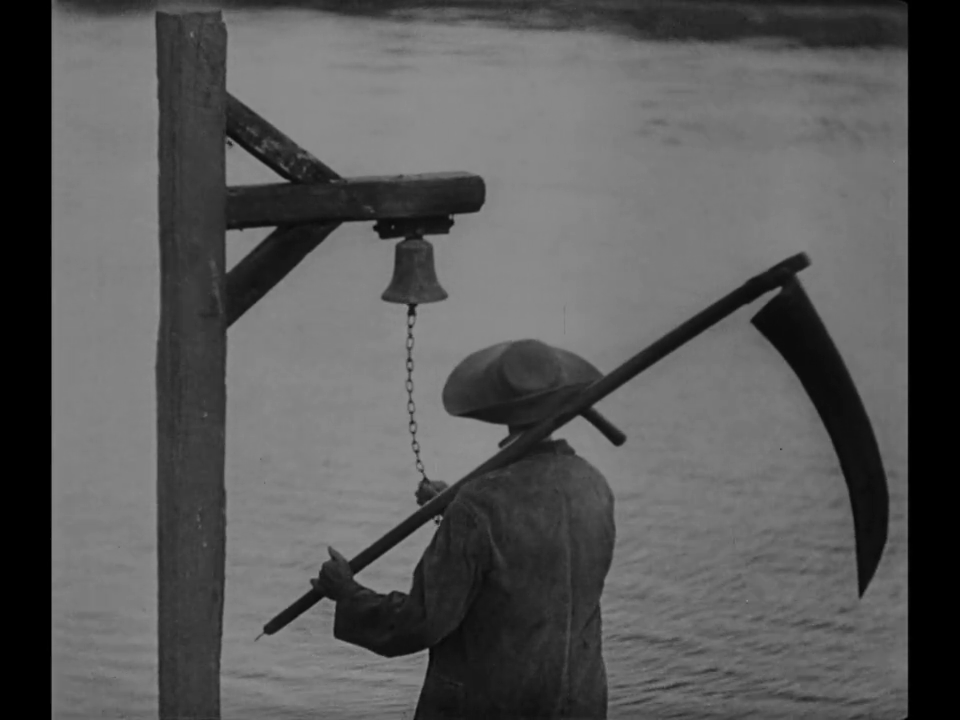
… shadows dancing on the inn’s wall:
… possessed Leone’s evil face shown in close up as she leers at her sister:
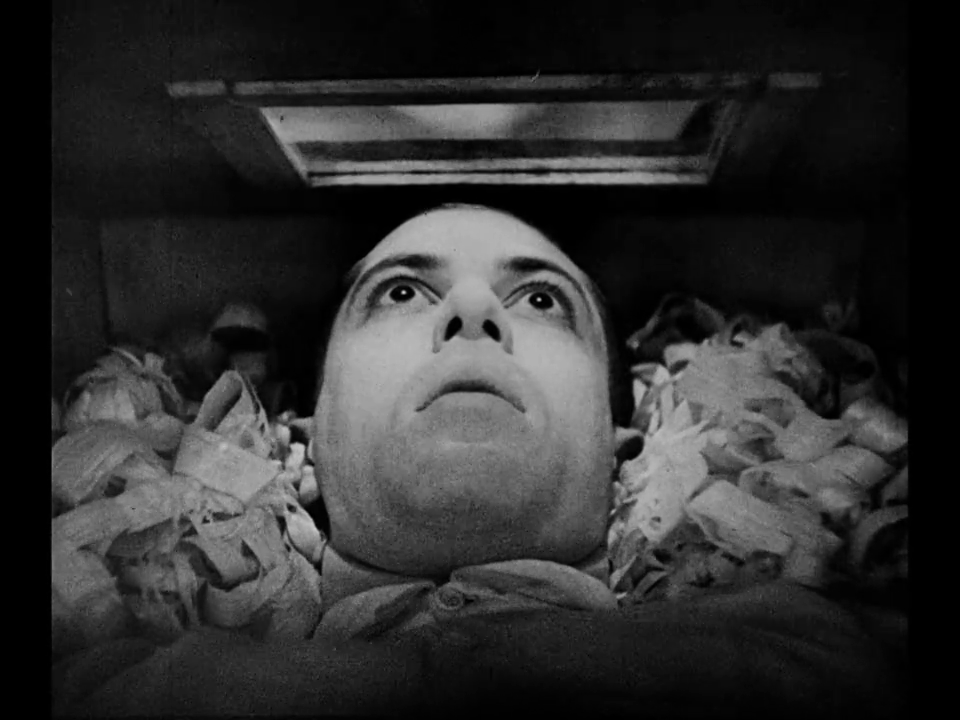
… [and] a death in a flour mill” — and he notes that “the whole film has an effectively haunting, misty look due to the use of gauze in front of the camera.”
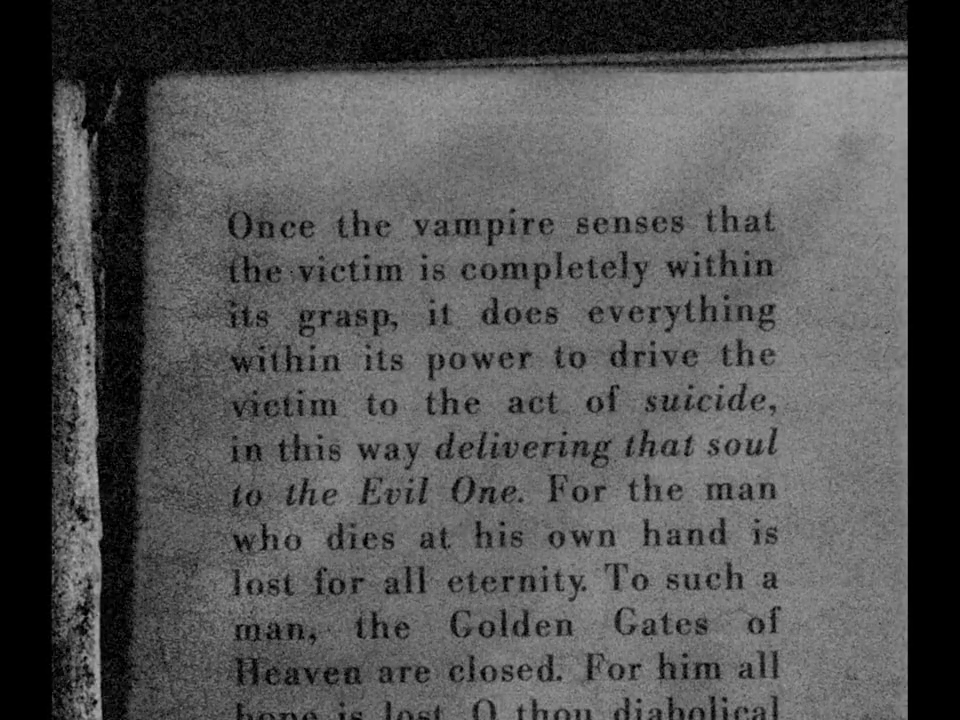
However, while Peary and every other reviewer I’ve read seem quite taken by this intentionally ethereal mood piece (made during a transitional period between silent films and talkies), I was much less engaged. Non-actor West — who funded the film, thus securing a role for himself — simply wanders through a pair of houses watching admittedly eerie and incomprehensible imagery playing out, while far too many pages from the book he’s received about vampires are shown on screen for us to read at regular intervals.
Meanwhile, I’m hard-pressed to see much evidence in the surreal narrative of “the conflict between the heart and the brain for the soul” — though clearly there’s plenty here for those so inclined to interpret in a variety of ways. Redeeming Qualities and Moments:
Must See? (Listed in 1001 Movies You Must See Before You Die) Links: |
“You’re gonna need a bigger boat.”
|
Synopsis: |
|
Genres, Themes, Actors, and Directors:
Response to Peary’s Review: Peary highlights the “excellent camera work by Bill Butler and special effects by Robert A Mattey under difficult conditions,” which have been discussed at length in various documentaries about the making of the film. He notes that the “first attack is a shocker”:
… the “entire boat sequence is nerve-wracking”:
… and “solid performances from the three leads (whose volatile conversations on the boat are quite enjoyable) give this film” — which “became a box-office phenomenon” — “real class”.
Indeed, this breakthrough film for Spielberg — who apparently was convinced each day that he would be fired, and that his career in filmmaking would come to a premature end — is arguably his best. I agree with Richard Scheib in his review for Moria, where he writes: “Spielberg demonstrates a real mastery – one that he has never fully demonstrated again – in detail, in character and most of all in the ability to manipulate the audience with shock and suspense.”
Note: Of special interest during COVID-19 times is how spot-on the film is in naming the political and financial drivers behind reckless disregard for public safety. As the mayor points out (where have we heard this before?): “Amity is a summer town — and we need summer dollars.” Redeeming Qualities and Moments:
Must See? Categories
(Listed in 1001 Movies You Must See Before You Die) Links: |
“Excuse me: I couldn’t help noticing that strange and unusual plant!”
|
Synopsis: |
|
Genres, Themes, Actors, and Directors:
Review:
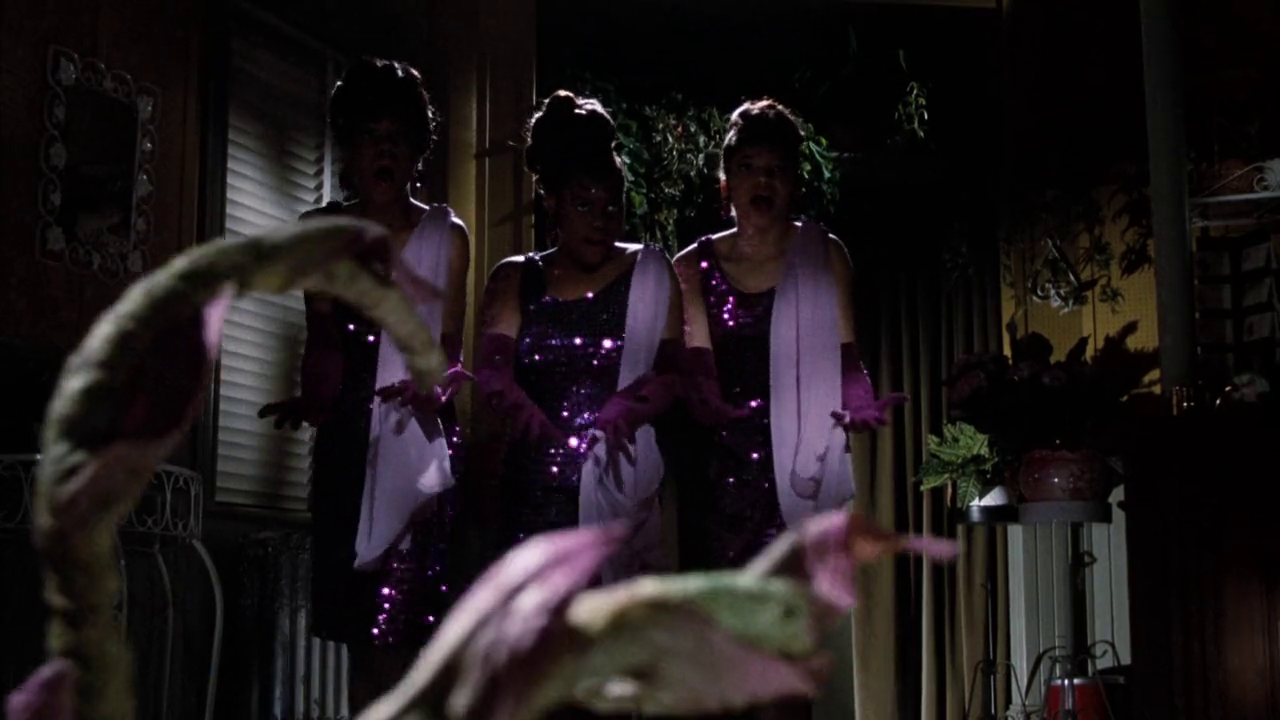
Perhaps most impressive, however, is Frank Oz’s puppeteering of “Audrey II”, which grows from a tiny and seemingly harmless potted houseplant:
… to a fully-grown force-to-be-reckoned-with:
[SPOILERS] … to a Godzilla-like monstrosity that has taken over the Earth:
(This ultra-dark, apocalyptic ending was the original one conceived and filmed by Oz; it was altered to something cheerier for theatrical release, but has now been restored.) Also amusing are various cameos by comedic favorites — especially Steve Martin and Bill Murray’s interactions as a sadistic dentist who encounters his most enthusiastic patient ever. Redeeming Qualities and Moments:
Must See? Categories
Links: |
“The water is filled with carnivorous fish: piranha.”
|
Synopsis: |
|
Genres, Themes, Actors, and Directors:
Response to Peary’s Review:
… and Dick Miller, as the money-hungry resort owner:
… are funny,” their “broad humor doesn’t mesh with the tongue-in-cheek satirical upstream story [?] with Dillman and Menzies,” and it “should all have been played straight.” I think Peary is being overly harsh on this flick, which effectively builds off of Jaws while offering plenty of genuine chills and thrills. The idea of genetically modified fish with teeth swarming in the water is enough to terrify me — and it’s pretty ridiculous to complain that swimmers would get to shore within 10 seconds if they’re being attacked and bitten to death by ravenous hordes of critters. Meanwhile, plenty of authentic suspense is built into Sayles’s screenplay — i.e., when the raft Menzies and Dillman are using to flee starts unraveling due to the piranhas eating away at its bindings:
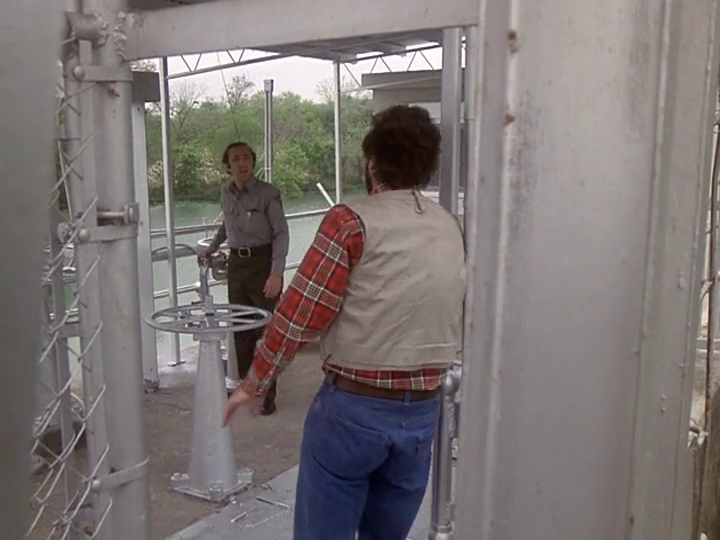
… and when Dillman is racing against time to prevent a dam operator from releasing the water:
… and all the sequences in which innocent swimmers (including plenty of kids) are about be swarmed. Redeeming Qualities and Moments:
Must See? Links: |
“There seems to be a killer instinct — frequently blind, pointless — running through the entire animal kingdom.”
|
Synopsis: |
|
Genres, Themes, Actors, and Directors:
Review:
… and poor Malden is given a thankless role as a secretly deranged villain:
Most impressive is make-up expert Charles Gemora’s work on the gorilla suit used for a critical primate character in the film; it’s remarkably authentic and effective. Redeeming Qualities and Moments:
Must See? Links: |