D.O.A. (1950)
“I don’t think you fully understand, Bigelow — you’ve been murdered!”
“I didn’t start shooting at anyone that didn’t start shooting at me first.”
|
Synopsis: |
|
Genres, Themes, Actors, and Directors:
Response to Peary’s Review: (Harry himself states at one point, “I hate the goddamn system, but until someone comes along with changes that make sense, I’ll stick with it.”) The film’s title (magnums are ultra-powerful cartridges) hints at an emphasis on firearms and ballistics throughout, and the scene in which Eastwood battles Soul for top prize in a shooting contest is particularly exciting. However, I could do without the inane “subplot” involving Harry’s sexually available Asian neighbor (Adele Yoshioka), whose two-dimensional presence merely serves to tap into Orientalist fantasies. Redeeming Qualities and Moments:
Must See? Links: |
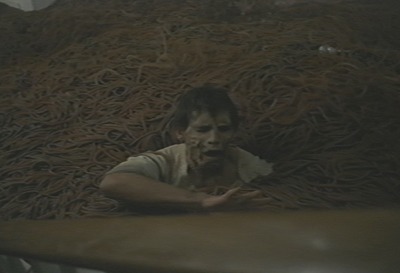
“Something is making the worms go crazy.”
|
Synopsis: |
|
Genres, Themes, Actors, and Directors:
Response to Peary’s Review: Redeeming Qualities and Moments: Must See? Links: |
“This murder will happen again, just as it did before — in the Black Room!”
|
Synopsis: |
|
Genres, Themes, Actors, and Directors:
Review: Redeeming Qualities and Moments: Must See? Categories
Links: |
“We’re not going to leave you alone until I get the ring, okay?”
|
Synopsis: |
|
Genres, Themes, Actors, and Directors:
Review: P.S. See Mike Newell’s Into the West (1992) for a comparable — albeit more strategically crafted — film about modern-day Irish gypsies (known as “Travellers”) in Dublin. Redeeming Qualities and Moments: Must See? Links: |
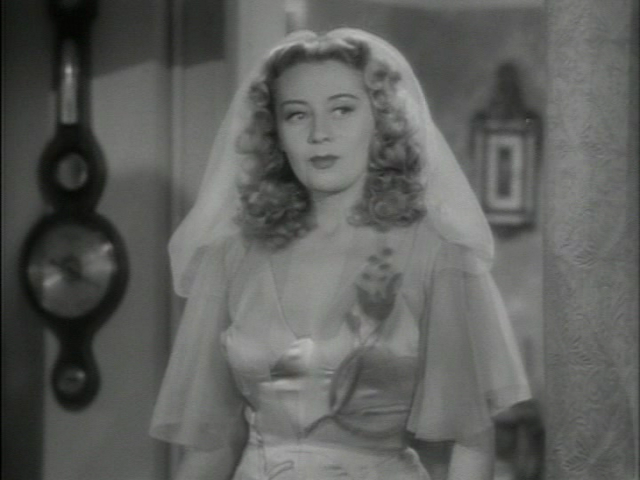
“It isn’t every day a girl gets murdered!”
|
Synopsis: |
|
Genres, Themes, Actors, and Directors:
Review: Redeeming Qualities and Moments: Must See? Links: |
“Topper’s too nice a fella to be in trouble… I’m going to get him out!”
|
Synopsis: |
|
Genres, Themes, Actors, and Directors:
Review: And while Young’s slapsticky pratfalls were amusing in the first film, they’re overused for laughs here. As usual, Burke’s bubble-headed socialite (“Too bad the people in America aren’t French”) is insufferable: and reliable character actors Franklin Pangborn (with a bad French accent): and Alan Mowbray are simply wasted. Topper Takes a Trip is, unfortunately, “comedy” at its low-brow worst, and certainly not must-see viewing. Redeeming Qualities and Moments: Must See? Links: |
[Note: The following review is of a non-Peary title; click here to read more.]
“Your dead one was a very important man.”
|
Synopsis: |
|
Genres, Themes, Actors, and Directors:
Review: Heston — “an actor who has had better last movie lines than any other star”, according to Stomp Tokyo’s reviewers — is appropriately stalwart as the hard-nosed detective who is determined to uncover the conspiracy behind Cotten’s death: but is never above taking advantage of the amenities (namely wildly overpriced foodstuff) he encounters during his investigation. Meanwhile, Robinson is a class-act in his final role as Heston’s roommate, a “Book” (so-named because he actually reads) who remembers long-gone days of bountiful flora and fauna on Earth; his delight at eating a piece of genuine beef is a joy to watch, and his final scene in the film (considered hokey by some) never fails to move me to tears. I’m also impressed by the simple yet effective way in which New York City is portrayed as drastically overpopulated, with Heston literally crawling over live bodies sprawled up and down stairwells, and crowd members serving as gruesomely effective “body armor” during assassination attempts. The film’s main flaw is its decidedly anti-feminist portrayal of women, who are (for the most part) either kerchief-clad personae non gratae, or beautiful and sexually compliant “furniture” (ouch!) for wealthy men — yet this gender-biased vision of the future is, sadly, perhaps not all that unrealistic, making Soylent Green all the more effective as a disturbing cautionary tale. Redeeming Qualities and Moments:
Must See? Categories
Links: |
“It’s simple: either you want to play football again, or you don’t.”
|
Synopsis: |
|
Genres, Themes, Actors, and Directors:
Review: … they’re saddled with such an awkward, muddled script (the synopsis above barely touches on the complexity of the dense plot, which involves insider gambling and high-level corruption) that it’s difficult to care about either their ill-fated romance or their respective predicaments. Ward’s family problems — she’s the spoiled, petulant daughter of a wealthy land developer — are never fully explored, and she fails to project the necessary edginess or complexity of a truly compelling femme fatale. Meanwhile, James Woods is either badly miscast or badly directed in a pivotal role as Ward’s covetous lover: While no one would ever accuse Woods of an inability to project “slime”, he nonetheless fails to embody the “Mr. Big” presence required of his character here. Worst of all, however, is director Taylor Hackford’s decision to have his actors spout neo-noir dialogue (“I love you, Jessie. Why did that have to be a bad thing?”) as though it’s realistic banter; attempts to infuse this type of hardboiled rhetoric into modern cinematic settings (c.f. Rian Johnson’s Brick, 2005) are tricky at best, and the effort fails completely here — it’s almost laughable, but (sadly) not quite. Not even the presence of cinematic icon Richard Widmark (badly underused): … or Out of the Past‘s original star, Jane Greer: … can revive this disappointing thriller, which should be much better than it is. Redeeming Qualities and Moments: Must See? Links: |
“I told you I’m not an actress. I also told you I lie all the time. Draw your own conclusion!”
|
Synopsis: |
|
Genres, Themes, Actors, and Directors:
Review: Director Anthony Harvey and cinematographer Gerry Turpin do a reasonably impressive job cinematizing what is by its very nature a claustrophobic, geographically-limited playlet, and John Barry’s pulsating score is appropriately jarring — but the truth is that Dutchman (even at such a short running time) remains a bit of a chore to sit through, due primarily to Knight’s insufferable central performance. While subtle characterizations are perhaps too much to ask for in such a heavily weighted allegory, Knight’s performance is (as noted in Nathan Rabin’s DVD review for The Onion) “embarrassingly theatrical, a tour-de-force of histrionics that only underlines the pretentious, feverishly overwritten nature of Jones’ script.” Freeman — infinitely subtle in comparison — fares somewhat better, but can’t help being overshadowed by Knight’s hideous gargoyle of a femme fatale. Redeeming Qualities and Moments: Must See? Links: |