Browsed by
Category: Response Reviews

My comments on Peary’s reviews in Guide for the Film Fanatic (Simon & Schuster, 1986).

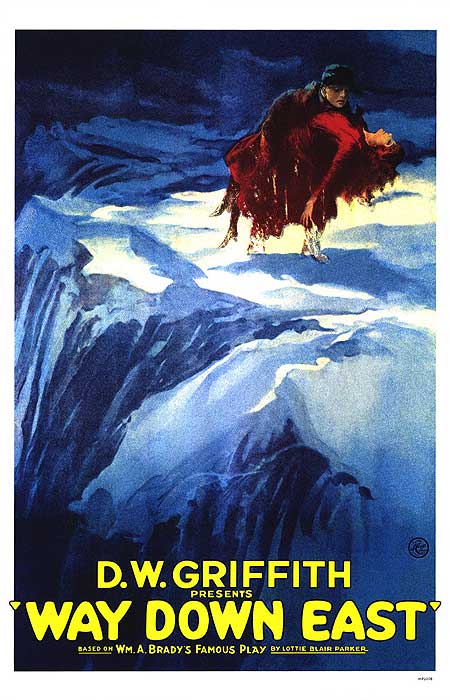
Way Down East (1920)

Way Down East (1920)

“Don’t worry; everything’s all right. Don’t you trust me?”

Synopsis:
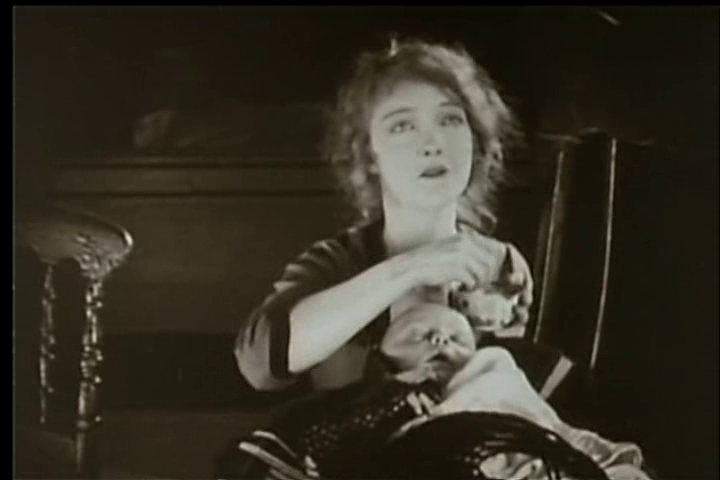
A naive country girl (Lillian Gish) is deceived by a womanizing player (Lowell Sherman) into believing she’s married him, and bears a child out of wedlock. After the baby dies and Sherman abandons her, she starts her life over by working as a maid for a squire (Burr McIntosh), whose son (Richard Barthelmess) falls in love with her. But can she escape her “shameful” past?

Genres, Themes, Actors, and Directors:

  • D.W. Griffith Films
  • Feminism and Women’s Issues
  • Lillian Gish Films
  • Play Adaptation
  • Silent Films
  • Womanizers

Response to Peary’s Review:
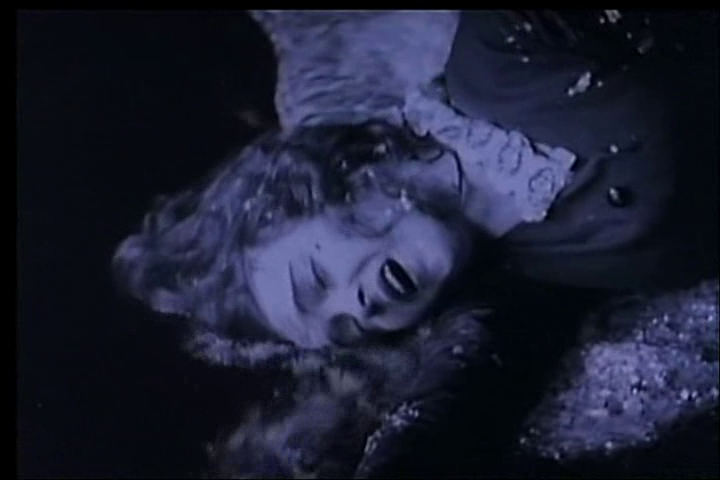
Peary argues that D.W. Griffith’s adaptation of Lottie Blair Parker’s popular 19th century melodrama remains “the best of [his] pastoral films”, noting that rather than relishing “the chance to make a woman suffer, [he] doesn’t try to milk the audience’s tears”, and makes Gish’s Anna “resilient in her many hardships” so that we “want to admire Anna, not pity her”. Despite Gish’s fine central performance, however — and the justifiably famous finale in which “the freezing Gish walks perilously across ice floes during a blizzard” (using no stunt doubles) — Way Down East remains more of a curiosity than a true classic. There’s nothing particularly new about the heartbreaking storyline (one contributor on IMDb points out the uncanny narrative similarities with Thomas Hardy’s Tess of the D’Urbervilles), and Griffith’s portrayal of country yokels as foolish rubes quickly moves beyond “humor” into tiresome and offensive caricature. With that said, film fanatics will probably be curious to check this one out simply given its historical relevance; it was Griffith’s second most popular film after The Birth of the Nation (1915).

Note: Another contributor on IMDb notes that she’s shown this film to her high school students for years as an archetypical example of Victorian melodrama — which makes complete sense.

Redeeming Qualities and Moments:

  • Lillian Gish as Anna
  • An occasionally heart-breakingly melodramatic script
  • G.W. Bitzer’s cinematography
  • The exciting icy climax

Must See?
Yes, but only for its historical relevance.

Categories

  • Historically Relevant
  • Important Director

(Listed in 1001 Movies You Must See Before You Die)

Links:

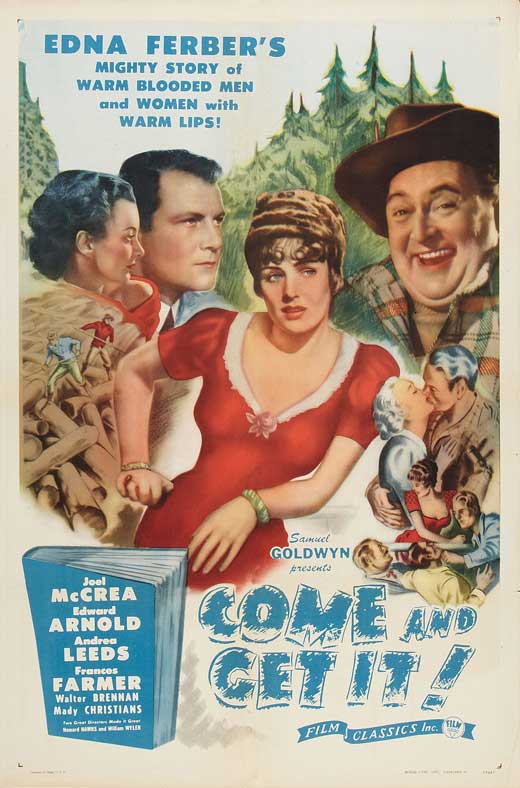
Come and Get It / Roaring Timber (1936)

Come and Get It / Roaring Timber (1936)

“In ten years, I’m going to be one of the richest men in this state! You wait and see.”

Synopsis:
An ambitious lumberjack (Edward Arnold) marries the daughter (Mary Nash) of his business partner rather than the woman he really loves — saloon singer Lotta Morgan (Frances Farmer). Years later, he meets Lotta’s daughter (also Frances Farmer), and falls immediately in love with her — as does his son (Joel McCrea).

Genres, Themes, Actors, and Directors:

  • Edward Arnold Films
  • Frances Farmer Films
  • Historical Drama
  • Howard Hawks Films>
  • Joel McCrea Films
  • Rivalry
  • Walter Brennan Films
  • William Wyler Films

Response to Peary’s Review:
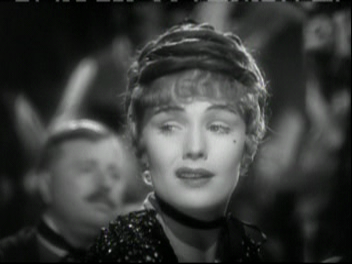
Peary’s response to this “well-mounted Samuel Goldwyn production of Edna Ferber’s novel” — “the only major film of Frances Farmer’s career” — is a bit of a surprise. He states that Farmer is “not so impressive that we can lament about how great her career would have been if Hollywood hadn’t destroyed her”, and argues that while “she is certainly capable and shows signs of intelligence”, “what’s most striking is how closely Jessica Lange resembles her in Frances“. I completely disagree. From the moment we first lay eyes on Lotta Morgan (Farmer in the first of dual roles), it’s difficult to look away: she’s both gorgeous and spunky, with a modern sensibility. In her second role (as Lotta Bostrom), she’s equally engaging, portraying just the right mix of a small town girl’s drive to make something of herself, and increasing dread at the realization of exactly what Arnold’s intentions are with her. Farmer is really the primary reason to see this movie, and film fanatics will be glad for the opportunity.

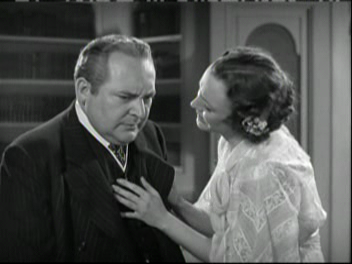
With that said, it’s a fine movie in many other respects as well. While it is a bit of a “conventional soaper” at times, the fact that it “becomes uncomfortable to watch in the second half [once] Arnold comes across as a ‘dirty old man'” simply adds to its authenticity. Indeed, the screenplay refreshingly never shirks away from dealing head-on with its somewhat disturbing premise, as married Arnold repeatedly fails to see exactly how creepy and inappropriate his advances towards young Lotta are. Clearly not a conventional leading man, Arnold (giving a “strong performance”) was an inspired choice to play the lead character here, with his bullish demeanor making it easy to sympathize with young Lotta’s dread. While I’m not particularly enamored by Walter Brennan’s Oscar-winning portrayal as Arnold’s best friend Swan (his broad Swedish accent comes across as a bit too heavy-handed at times), there are several fine supporting performances throughout — most notably Mady Christians as Lotta Bostrom’s concerned cousin, and Andrea Leeds as Arnold’s grown daughter (they have a particularly touching scene together). Watch for Brooke Shields’s grandfather, Frank Shields, in a bit role as Arnold’s daughter’s beau.

Note: This film was co-directed by Howard Hawks and William Wyler (with the latter taking over towards the end, and contributing far less).

Redeeming Qualities and Moments:

  • Frances Farmer as both Lottas

  • Edward Arnold as Barney
  • Fine supporting performances
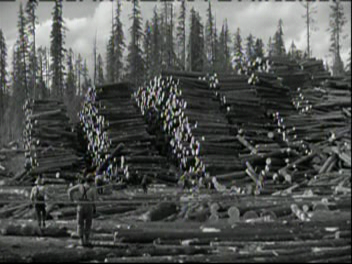
  • The stunning, if disturbing, logging sequences near the beginning of the film

Must See?
Yes, primarily for Farmer’s performance, but also as a good show all around.

Categories

  • Noteworthy Performance(s)

Links:

Rebecca (1940)

Rebecca (1940)

“Marriage with Max is not exactly a bed of roses, is it?”

Synopsis:
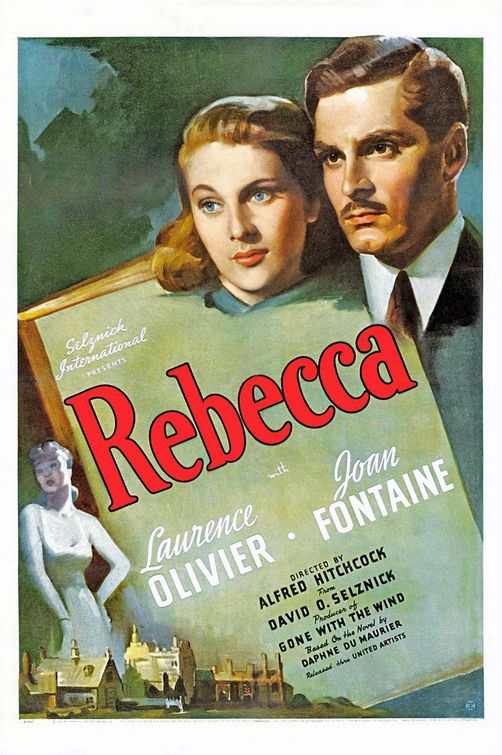
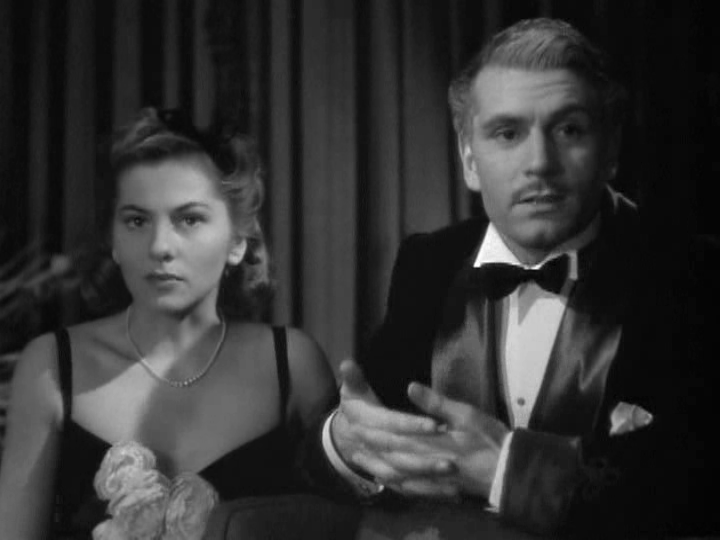
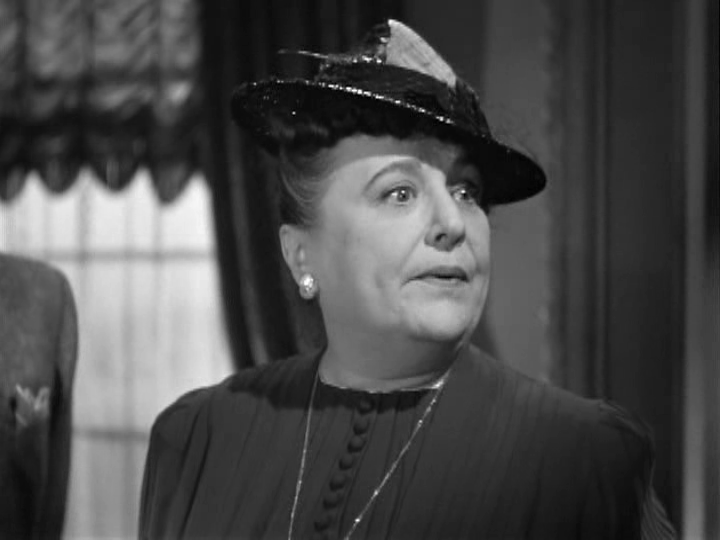
The shy personal assistant (Joan Fontaine) of a brash society lady (Florence Bates) falls in love with a wealthy widower (Laurence Olivier) whose deceased wife, Rebecca, continues to haunt the memories of those she left behind.

Genres, Themes, Actors, and Directors:

  • George Sanders Films
  • Hitchcock Films
  • Joan Fontaine Films
  • Judith Anderson Films
  • Laurence Olivier Films
  • Widows and Widowers

Response to Peary’s Review:
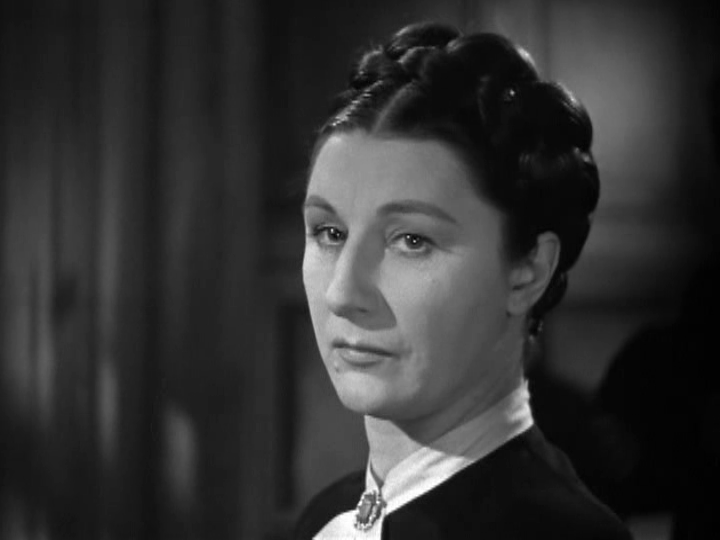
The unnamed heroine in Daphne DuMaurier’s best-selling gothic romance novel — simply referred to as “the second Mrs. DeWinter” — represents the fulfillment of most girls’ dreams: a mousy, self-effacing young woman in an unsatisfying job, she is literally swept off her feet by a handsome millionaire, and taken to live in a gorgeous, postcard-perfect mansion in the English countryside. The fairy tale quickly turns sour, however, once the new Mrs. DeWinter (played here by Joan Fontaine in her “captivating” leading-role debut) encounters the household’s domineering housekeeper, Mrs. Danvers (Judith Anderson) — a “witch in black” — and realizes that her position as lady of the house will be continuously overshadowed by a “ghost” (the memory of her husband’s larger-than-life former wife, Rebecca). The tautly scripted three-act narrative of this Oscar-winning “best picture” neatly takes us through Fontaine’s whirlwind romance with Mr. DeWinter (Laurence Olivier), her insecurity as mistress of a household haunted by its troubled past, and a police investigation in which numerous secrets are revealed and Fontaine’s loyalty to her husband is severely tested.

If Rebecca isn’t “great Hitchcock” (it doesn’t stand among his very best work), it’s still fine entertainment. The performances throughout are uniformly excellent, with Olivier appropriately haunted and restrained as Fontaine’s brooding husband, and Fontaine perfectly portraying the brew of conflicted emotions felt by her character, who remains both nervously submissive and incredulous about her position until a pivotal shift in the plot later on (a point at which Peary argues the film “loses its power”, but I disagree). The supporting cast is fine as well, with Anderson delivering the performance of her lifetime as disturbed Mrs. Danvers (Peary refers to her portrayal as “chilling” and “soulless”); George Sanders briefly stealing the scenery in a characteristically smarmy role later in the film; and Florence Bates nicely capturing the essence of an overbearing society woman who borders on caricature but just manages to avoid this fate (listen to her conflicted reaction upon hearing about her assistant’s sudden engagement to Mr. DeWinter). A combination of appropriately spooky sets (Manderlay is a truly haunted house), George Barnes’ Oscar-winning “atmospheric cinematography”, “Franz Waxman’s moody score”, and “the clever way Hitchcock uses space so that Fontaine seems dominated by her surroundings” contribute to the film’s “amazing tension”, and turn it into a suspenseful mystery we’re eager to keep watching.

Redeeming Qualities and Moments:

  • Joan Fontaine as the second Mrs. DeWinter (nominated by Peary as Best Actress of the Year in his Alternate Oscars book)
  • Laurence Olivier as Mr. DeWinter
  • Judith Anderson as Mrs. Danvers
  • George Sanders as Jack Favell
  • Florence Bates as Mrs. Van Hopper
  • Impressive sets
  • George Barnes’ cinematography
  • Franz Waxman’s score

Must See?
Yes, as Hitchcock’s only Oscar-winning picture (and one of only a few, shamefully, to even have been nominated).

Categories

  • Important Director
  • Oscar Winner or Nominee

(Listed in 1001 Movies You Must See Before You Die)

Links:

Suspicion (1941)

Suspicion (1941)

“Johnnie, I’m just beginning to understand you.”

Synopsis:
A bookish wallflower (Joan Fontaine) marries a charming rake (Cary Grant) who quickly arouses her suspicions when she discovers he is both a liar and a penniless thief.

Genres, Themes, Actors, and Directors:

  • Cary Grant Films
  • Hitchcock Films
  • Homicidal Spouses
  • Joan Fontaine Films
  • Marital Problems
  • Newlyweds
  • Plot to Murder

Response to Peary’s Review:
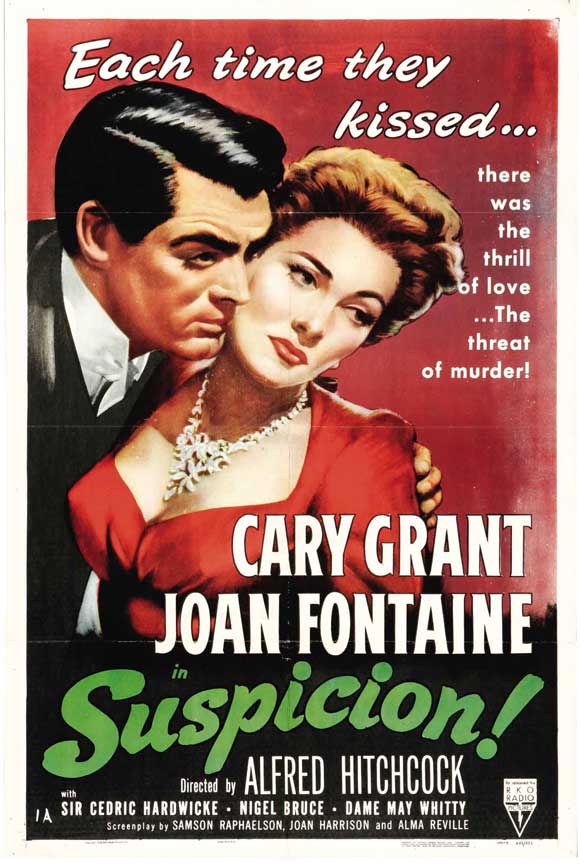
Peary spends the bulk of his review of this early American Hitchcock film — his follow-up to Rebecca (1940) — complaining about its ending (which, by the way, is discussed to some extent in nearly every online review — so be forewarned if you’ve never seen it). He notes that Fontaine “saves [the] picture with [her] gusty performance”, but claims that Grant simply “looks stiff”. He points out a couple of “good scenes — Grant carrying [a] glowing glass of milk to sick Fontaine, a dinner conversation about murder”, but ends his review by once again arguing that “the disappointing resolution keeps it from being top-grade Hitchcock”. I actually agree with Peary that this isn’t “top-grade Hitchcock” — but not just because of the ending. Although there’s a credible amount of tension throughout the entire film (which is told from Fontaine’s point of view), we’re quickly frustrated by her simpering unwillingness to act on her increasingly mounting suspicions.

It’s relatively easy to accept Fontaine’s whirlwind marriage to Johnnie as the consequence of an overly sheltered young woman fearing spinsterhood (certainly plenty of naive, desperate women in real life have married cads or outright psychopaths out of similar motivations) — but once she learns about his lies and financial indiscretions, there’s no excuse for her hesitation in getting out. We’re meant to believe that she simply can’t help herself (she’s too in love with Johnnie), but I don’t buy it. (Interestingly, she’s never given reason to worry about him cheating on her with another woman — which indicates that perhaps women will put up with a lot of nonsense in a marriage as long as they don’t believe their primacy as “woman number one” is being threatened.) Meanwhile, other elements of the screenplay are clumsy as well: how convenient is it, for instance, that Johnnie and Lina happen to be friends with a mystery novelist (Auriol Lee) who’s exploring various methods for untraceable murder? The origins of this friendship are never explained, so it comes across as simply a plot contrivance. With that said, Fontaine’s Oscar-winning performance — in a decidedly imperfectly written role — is fine, and film fanatics will likely be curious to see the movie for this reason alone.

Redeeming Qualities and Moments:

  • Joan Fontaine as Lina
  • Atmospheric cinematography

Must See?
Yes, simply for Fontaine’s Oscar-winning performance.

Categories

  • Important Director
  • Oscar Winner or Nominee

Links:

Broken Blossoms (The Yellow Man and the White Girl) (1919)

Broken Blossoms (The Yellow Man and the White Girl) (1919)

“The Yellow Man watched Lucy often. The beauty which all Limehouse missed smote him to his heart.”

Synopsis:
A teenage waif (Lillian Gish) abused by her adoptive father (Donald Crisp) finds refuge in the home of a kind Chinese shopkeeper (Richard Barthelmess).

Genres, Themes, Actors, and Directors:

  • Asian-Americans
  • Child Abuse
  • Cross-Cultural Romance
  • Donald Crisp Films
  • D.W. Griffith Films
  • Lillian Gish Films
  • Racism and Race Relations
  • Silent Films

Response to Peary’s Review:
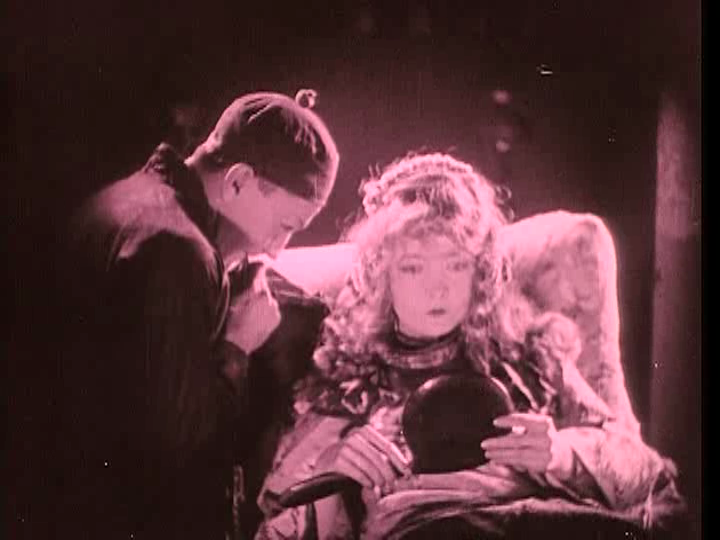
Peary refers to this “D.W. Griffith classic” — an unflinching early look at child abuse and racial prejudice — as “perhaps the cinema’s first outright tragedy”, yet points out that the use of various tints and the strategic employment of a “special soft-focus lens” gives the film “an almost poetic feel that tempers the harshness of the story”. He notes that the “overly sentimental” storyline (based on a short story by Thomas Burke) “surely appealed to Griffith because it again let him lash out at the evil city, again deal with miscegenation and suicide, and again — and this is the disturbing element — sacrifice an innocent girl to our cruel, immoral world.” Indeed, the three central characters are so elemental in their attributes — “snarling Crisp”, “stoical Barthelmess”, and timid Gish — that the wafer-thin story (not really suitable for a feature length film) comes across as more of a fable or a fairy tale than any kind of realistic narrative. This is especially true given that the age and developmental maturity of Gish’s character (Lucy) is left so vague: the 26-year-old Gish* could literally be either 10 or 15 or 20; she’s so petite and huddled over from fear at all times that we can’t really tell — and when Barthelmess hands her a doll to play with (!), we get seriously confused. (In the original short story, the character was 12 — which I suppose lends some credence to this scene.)

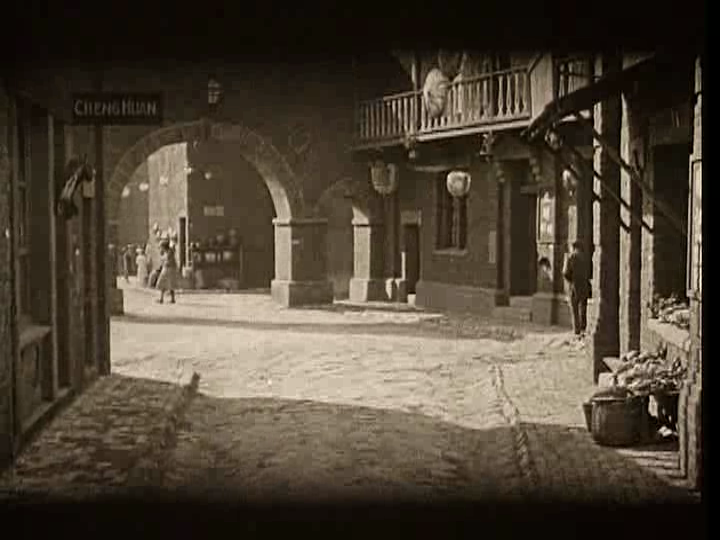
The film’s terribly antiquated, casually racist subtitle will likely turn many modern film fanatics off; but once they make tentative peace with both this and the (then standard) casting of white men in both central Asian roles, they’ll likely be pleasantly surprised to find that Griffith — the infamous director of America’s most egregiously racist classic film, Birth of a Nation (1915) — seems to at least be trying to portray the film’s Chinese-American protagonist (Cheng) in a reasonably respectful light. Indeed, it’s gratifying to know that Griffith “considered the main theme of his film to be that Americans wrongly consider themselves superior to foreigners, including the Chinese, who have a noble, peace-loving philosophy”. Cheng is shown at the beginning of the film to be a noble-minded Buddhist missionary hoping to convert European heathens to more peaceful ways — and thus his quick descent into opium addiction after arriving on the sordid shores of London is given a bit of context and justification, rather than simply perpetuating the trope of drug-addled Asians. (Actually, as I think about it, this piece of the narrative could easily have been expanded upon: I’d love to have seen more of Cheng’s travails upon arrival in London.)

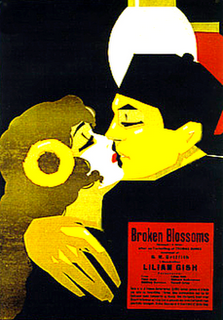
At any rate, Cheng’s poetically romantic yearnings towards Lucy could be (and are) explained away as merely a platonic desire to love and assist that which is most pure and good in the world — though, again, it would have been much more fulfilling to see this most unusual cinematic couple actually moving towards something “real” together. This would have required a more substantial storyline in general, but at least would have given a shred of credence to the fantastical poster (shown above). In terms of the lead performances, Peary accurately argues that “Crisp overacts”, “Barthelmess under-acts (as if he believed one change of expression would let us know that he isn’t really Oriental after all)” — but Gish “acts up an exciting storm”. He notes that “from her timid talking, stooped, crooked posture, and terrified eyes, Gish immediately gets us to understand that her beatings are a daily thing for her”, and she is “totally convincing” in the role. Her character’s ability to “smile only if she lifts the sides of her mouth her fingers” was apparently thought up by Gish herself, and remains one of the film’s most indelible (recurring) images.

* TCM’s article lists Gish as 23-years-old when the film was made, but this doesn’t make mathematical sense, given that IMDb cites 1893 as her birth year.

Redeeming Qualities and Moments:

  • Lillian Gish as Lucy, “the waif”
  • A (relatively) bold exploration of both child abuse and cross-cultural companionship
  • Billy Bitzer’s cinematography

Must See?
Yes; despite being “a bit disappointing”, it’s nonetheless considered a silent classic, and “is essential to any study of Griffith”. Selected to the National Film Registry, Library of Congress, in 1996. Available for free viewing at www.archive.org.

Categories

  • Genuine Classic
  • Historically Relevant
  • Important Director

(Listed in 1001 Movies You Must See Before You Die)

Links:

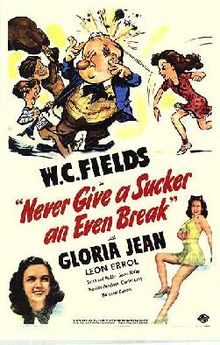
Never Give a Sucker an Even Break (1941)

Never Give a Sucker an Even Break (1941)

“He didn’t get that nose from playing ping-pong.”

Synopsis:
W.C. Fields (as himself) tries to convince movie producer Franklin Pangborn (as himself) to make a surreal movie starring Fields and his singing niece, Gloria Jean.

Genres, Themes, Actors, and Directors:

  • Comedy
  • Hollywood
  • W.C. Fields Films

Response to Peary’s Review:
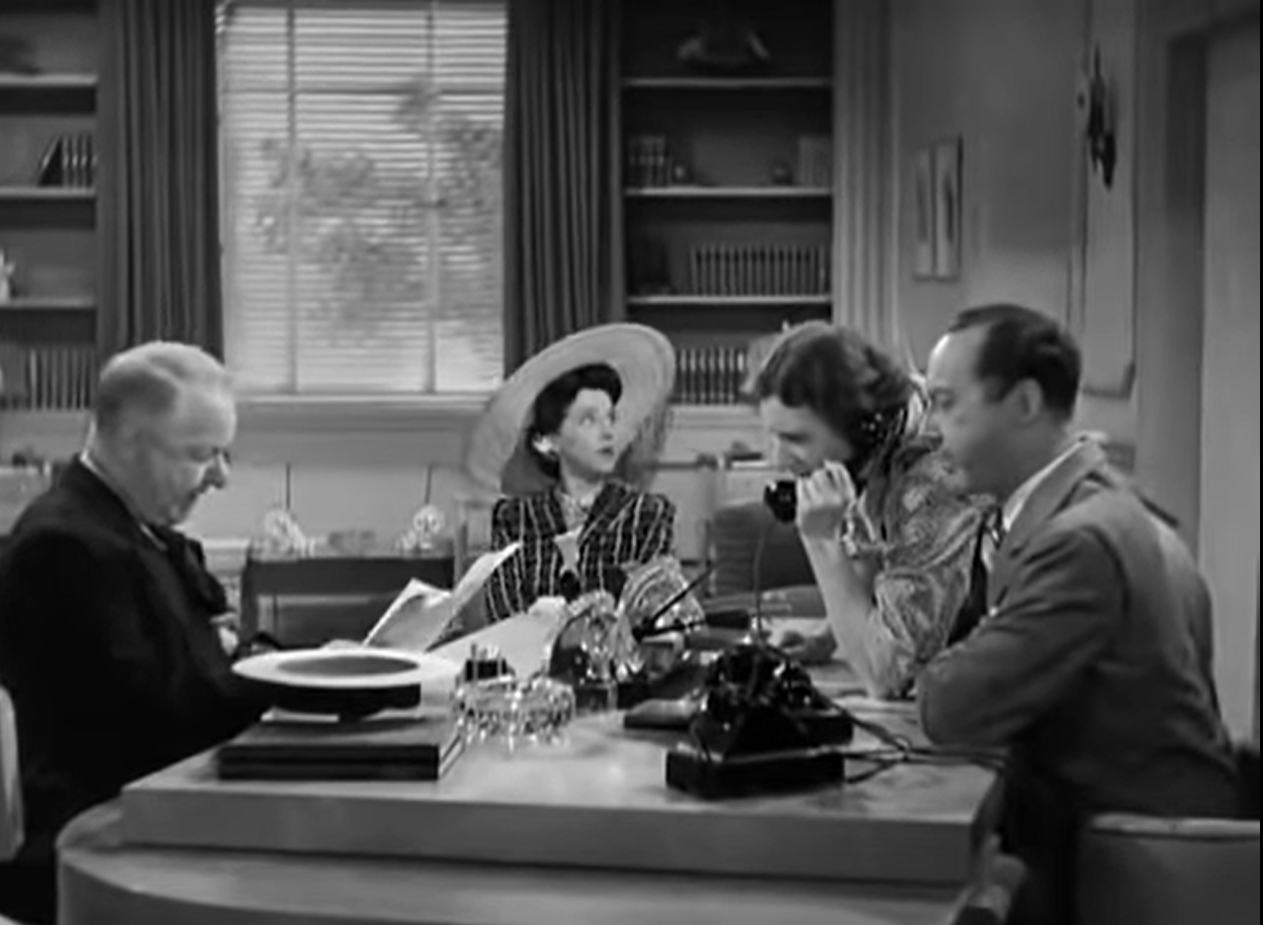
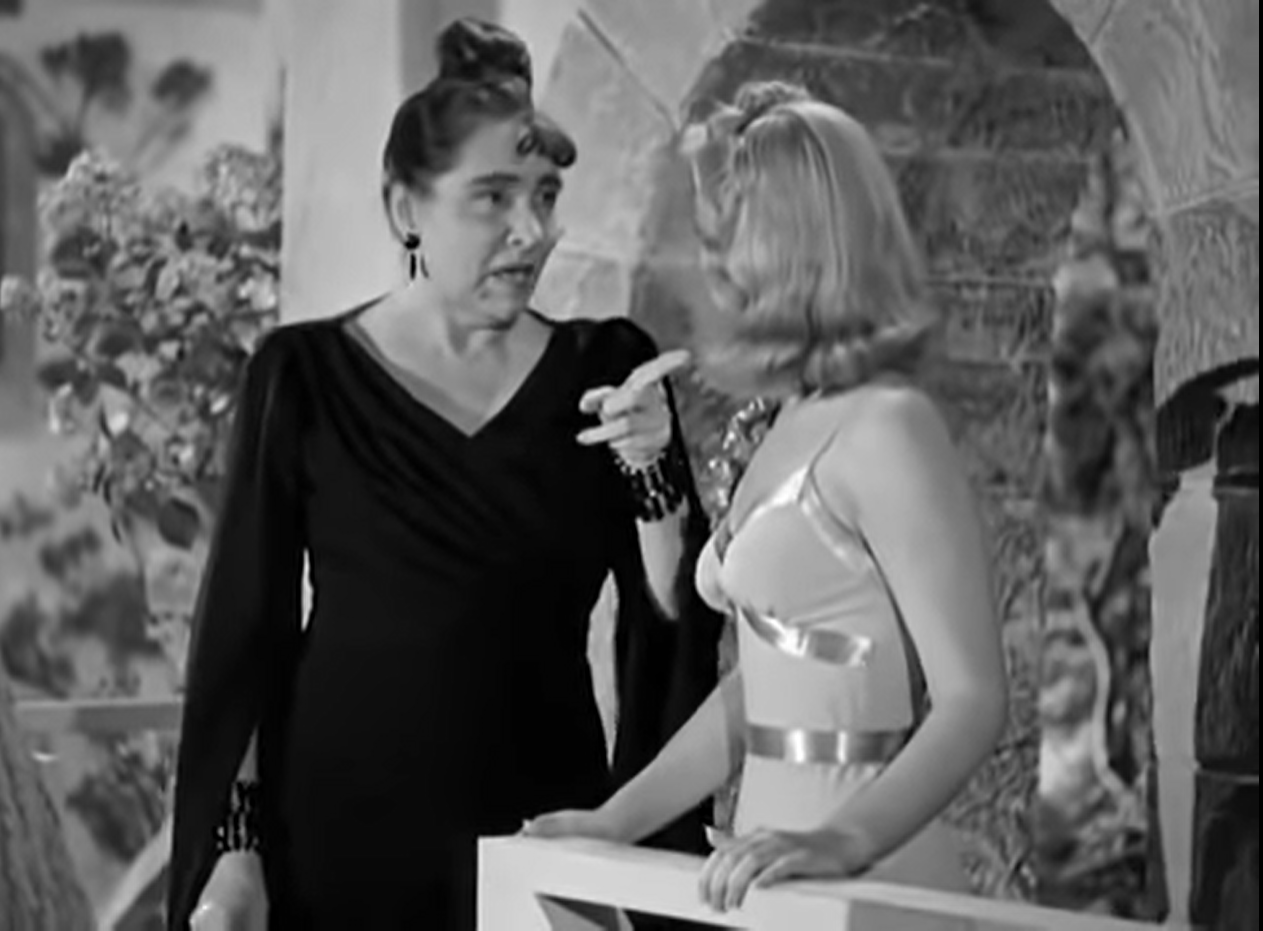
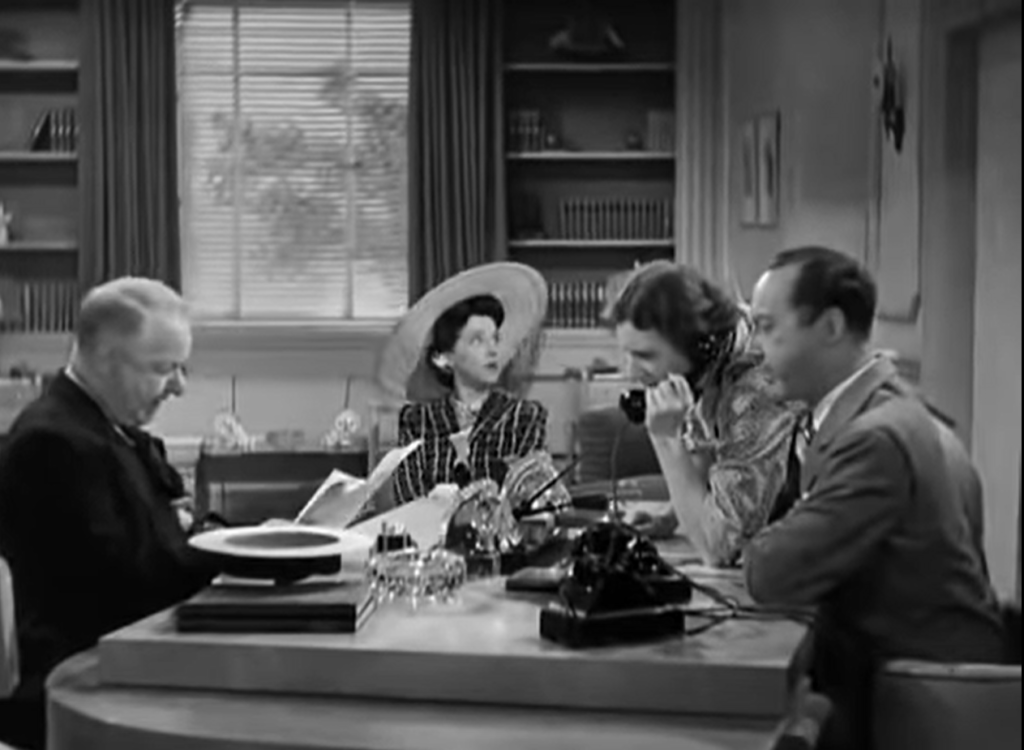
Peary argues that this “last starring role” for W.C. Fields isn’t “top-grade Fields because he isn’t on-screen enough…, he isn’t bombastic or aggravating enough, and he isn’t being constantly harassed by the nincompoops that usually populate his films” — but I have to say I disagree. While Fields might not be on-screen continuously, his presence as screenwriter (writing under the typically creative pseudonym of Otis Criblecoblis) is fully felt throughout, to joyfully surreal effect. Indeed, Peary does acknowledge that this is “the film where the surrealistic nature of Fields’s comedy is most evident”, given that the film-within-the-film (pitched by Fields to an exasperated Franklin Pangborn; what brilliant casting!:
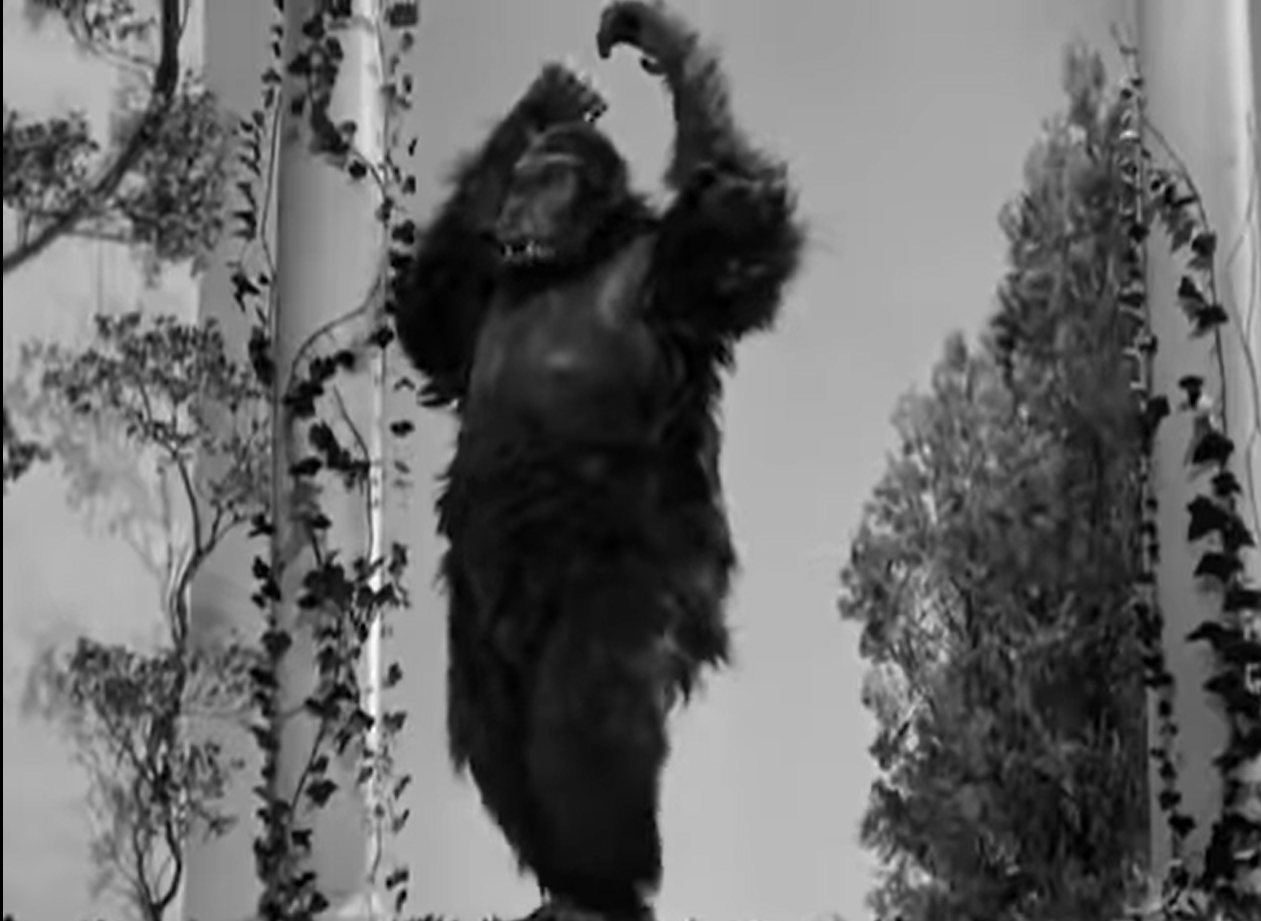
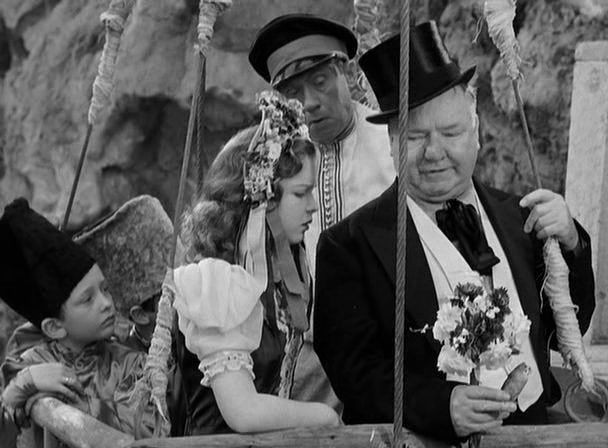
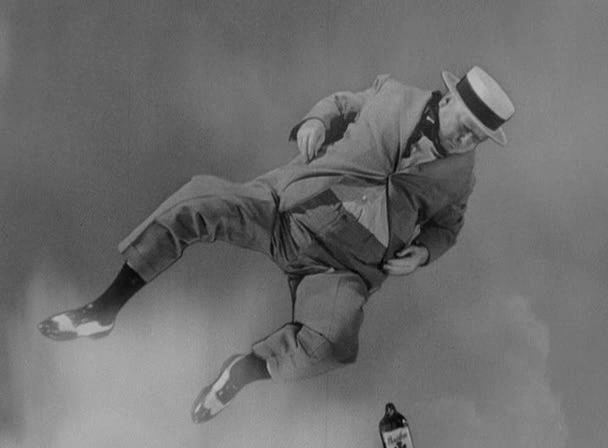
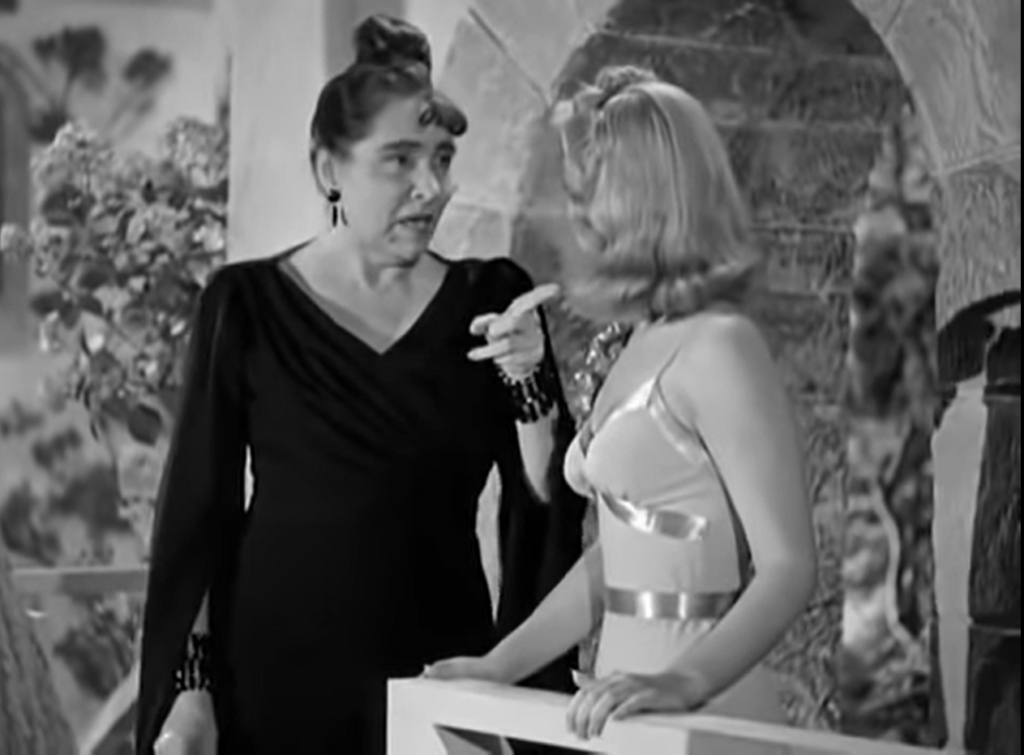
transpires in a fantastical alter-universe: Fields is traveling with his niece, Gloria Jean, on an airplane, when suddenly he “leaps… to retrieve his whiskey bottle and falls thousands of feet before landing safely on Margaret Dumont’s mountaintop estate, where she lives with her pretty young daughter:
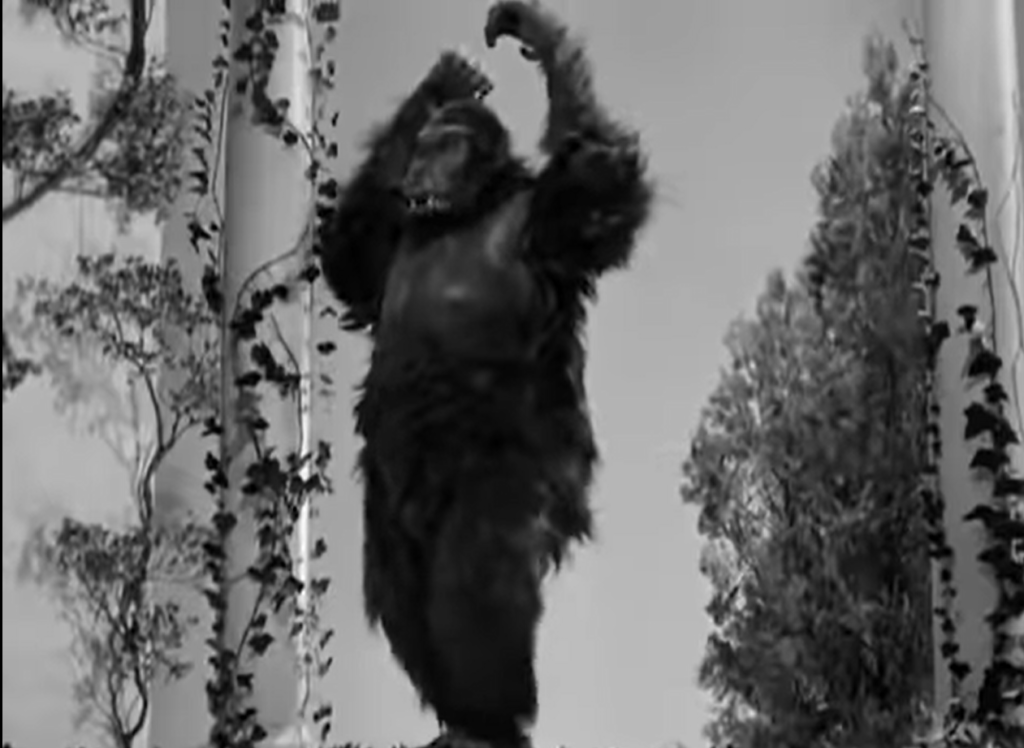
… a gorilla:
… and [a] Great Dane with fangs”:

… and later arrives at a Russian village in Mexico (!).

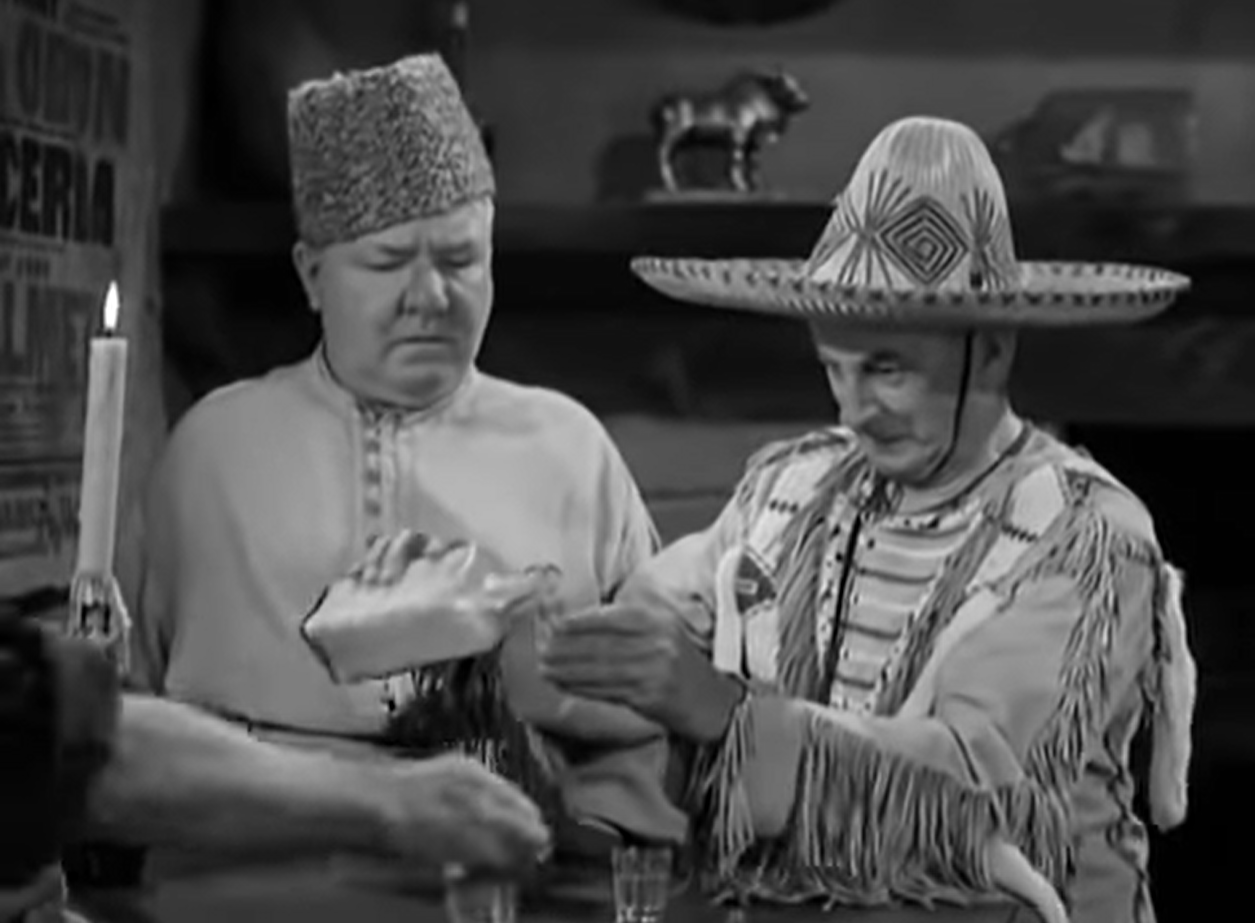
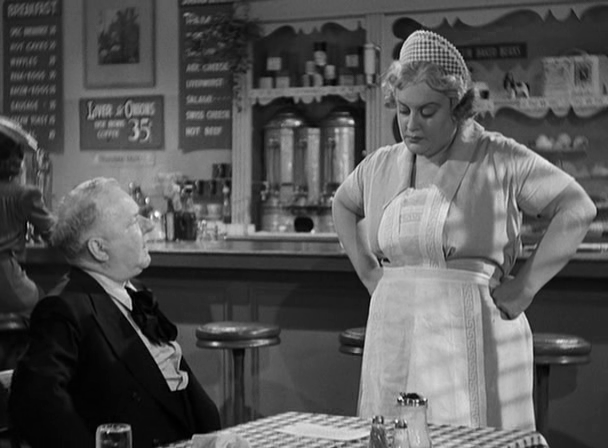
Truly, the preposterous scenario proposed by Fields — which Pangborn, naturally, rejects as “impossible, incomprehensible, inconceivable; and besides that, it’s no good” — seems to be the loopy product of both Fields’s accumulated years of experience on wackily hybrid studio sets (viz. the film’s opening sequences), and his constant inebriation, which is referenced continually throughout both the meta-narrative and the fantasy film. In one classic scene, for instance, Fields enters “an ice-cream parlor, where, before blowing the head off his ice-cream soda, he turns to us to reveal that censors wouldn’t let him stage the scene in a saloon”. Within the fantasy film, numerous laughs are milked (sorry) when Fields shares a stiff drink of goat’s milk (!) with an engineer (Emmett Vogan):

Fields would find intoxicating substances under a rock if necessary, it seems.

At any rate, your enjoyment of this film will ultimately depend upon how much you’re willing to forgo straightforward narrative in favor of something much more — dare I say, post-modern? Rewatching it again last night, after viewing and posting on numerous “pure” Fields films, I find myself enjoying it perhaps most of all, simply for its perversely illogical and “messy” status. Knowing in hindsight that this was to be Fields’s final starring role, it could be viewed as an especially apt “sayonara” — i.e., Fields’s attempt to throw everything plus the kitchen sink into his grand finale. At the same time, as Dave Kehr notes, the film “has an appealingly inward, mournful quality, as if it were a swan song that only its singer could hear. Unconcerned with reaching the audience, Fields seems to be muttering to himself through much of the movie, his barely audible remarks often achieving a strange poetry: ‘The chickens lay eggs in Kansas. The chickens have pretty legs in Kansas.'”

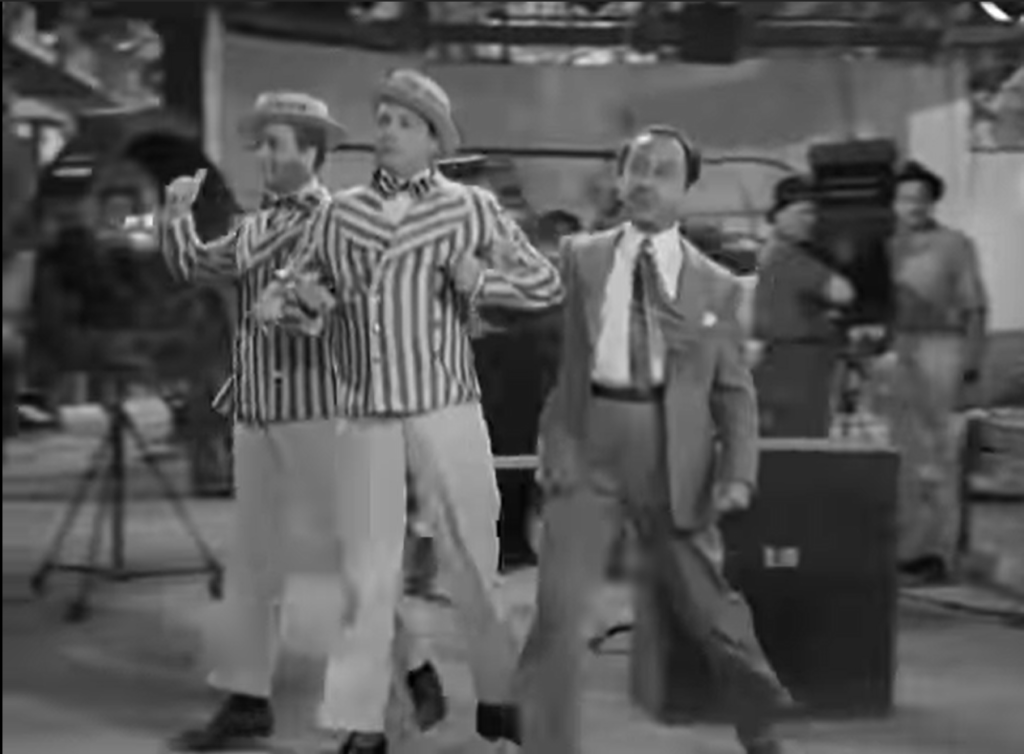
Note: My single favorite moment (over in an instant): Franklin Pangborn, agitatedly trying to help Gloria Jean rehearse, is momentarily caught up in a male chorus line dancing through the studio.
Redeeming Qualities and Moments:

  • W.C. Fields as himself
  • Franklin Pangborn as himself
  • Fields’s early interactions with a surly waitress (Jody Gilbert)
  • Fields’ enjoyably surreal screenplay
  • Plenty of characteristically zingy one-liners:

    “She drove me to drink, the one thing I’m indebted to her for.”

Must See?
Yes, as a truly surreal comedic effort — and for its historical relevance as Fields’ last film.

Categories

  • Good Show
  • Historically Relevant

Links:

Nutty Professor, The (1963)

Nutty Professor, The (1963)

“Professor Kelp’s just the kind of guy who might fool you.”

Synopsis:
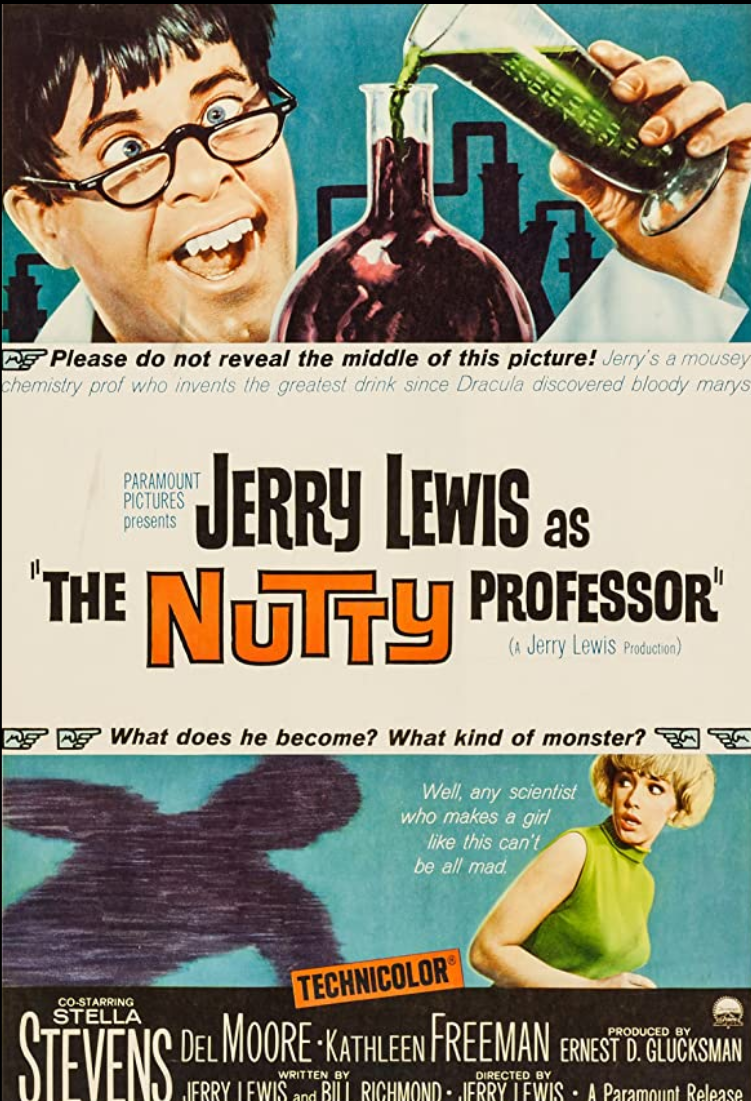
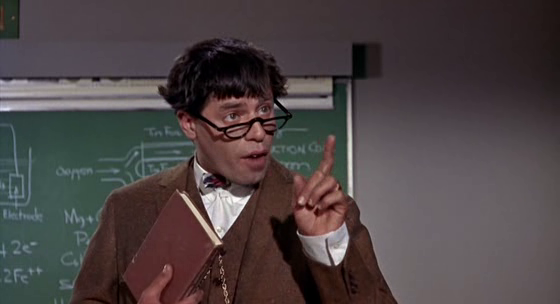
Julius Kelp (Jerry Lewis) — a nerdy chemistry professor with a crush on a beautiful student (Stella Stevens) — develops a potion which turns him into a narcissistic, womanizing singer named Buddy Love.

Genres, Themes, Actors, and Directors:

  • Comedy
  • Jerry Lewis Films
  • Mad Doctors and Scientists
  • Multiple Personalities
  • Professors
  • Stella Stevens Films

Response to Peary’s Review:
Peary has written quite a bit about this most famous of Jerry Lewis films, not only discussing it in the front section of his Guide for the Film Fanatic, but analyzing its cult appeal in his first Cult Movies book, and outlining the brilliance of Lewis’s dual performances in his Alternate Oscars book (where he casts a controversial vote for Lewis as Best Actor of the Year).

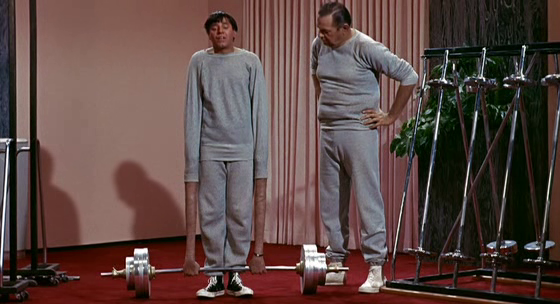
He refers to the film in general as “wildly inventive”, calling out Lewis’s “innovative direction and… witty screenplay” (co-written with Bill Richmond), which is full of countless hilarious moments — including inventive sight gags (such as the surreal consequence of Kelp trying to lift weights in a gym):

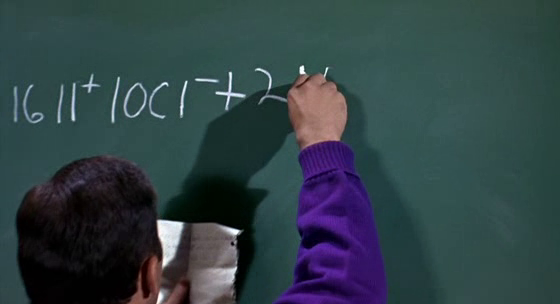
… remarkably effective use of sound effects for humor (as when Kelp enters his class with a raging hangover, and over-reacts to every noise made by his students):

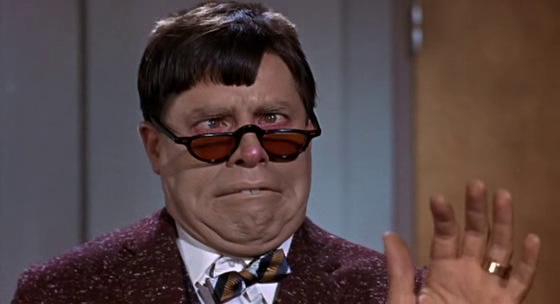
… and plenty of darkly humorous sequences with Buddy Love (which indicate that this film could in some ways be more accurately described as a “black comedy” than a straight “comedy”).

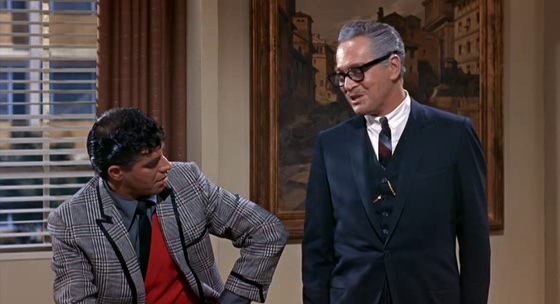
Indeed, Peary writes that “If The Nutty Professor is Lewis’s best film, and I believe it is, it is not so much because it is his funniest as because it is his most daring… in the sense that Lewis, who begs for love in all his other films, knew he was making a picture to which his greatest fans, children, would probably react negatively.” Love is a truly provocative character — someone so outrageously, obnoxiously arrogant (and cruel!) that one hesitates to laugh at him. (An exception is during the one Love scene played strictly for laughs: the truly chuckle-worthy sequence in which Love “gets into the… good graces of the dean [an excellent Del Moore] by complimenting him on his suit and flattering his acting ability, coaxing him into reciting Hamlet’s soliloquy while standing on top of a table and wearing the weird attire that Buddy hands him every time he tries to begin.”)

The rest of the time, however, one simply squirms uncomfortably at the notion that a half-rate, oily slickster like Love could genuinely charm an entire population of college students, and Stella Stevens in particular.

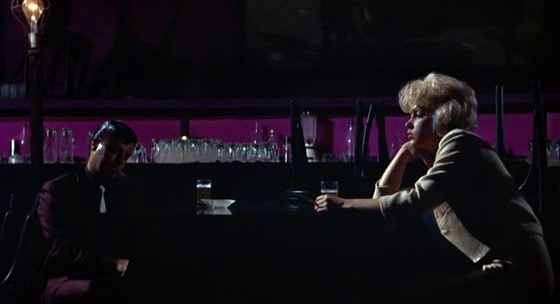
With that said, Stevens’ attraction to Love is decidedly complex: while Stevens (Peary argues this is her “best role in a comedy”) spends a bit too much time simply staring at Love or Kelp with either puzzled sympathy or annoyance, it’s clear that she’s genuinely trying to tease out the nature of her attraction to both men. She’s turned on by Kelp’s intelligence, but simultaneously drawn in — as if by hypnotic spell — to the web of Love’s allure, despite clearly recognizing the folly of her conflicted desire. Love himself has traditionally (and most facilely) been viewed as representing “Lewis’s ex-partner, the cocky, romantic-singing, and boozing Dean Martin” — but Peary (and others) note that Buddy is perhaps more accurately the “alter-ego of Jerry Lewis, the Lewis we see each year on the telethon: that conceited, sanctimonious, singing, angry older fellow who tries unsuccessfully at times to keep the funny-voiced ‘Kid’ bottled up inside him”. Check out Lewis’s 1969 interview with Dick Cavett (available on YouTube) for a classic representation of just this dynamic.

Redeeming Qualities and Moments:

  • Jerry Lewis as Julius/Buddy (selected by Peary as Best Actor of the Year in his Alternate Oscars)
  • Del Moore as Dr. Warfield
  • Stella Stevens as Stella Purdy
  • Hal Pareira’s memorable set designs
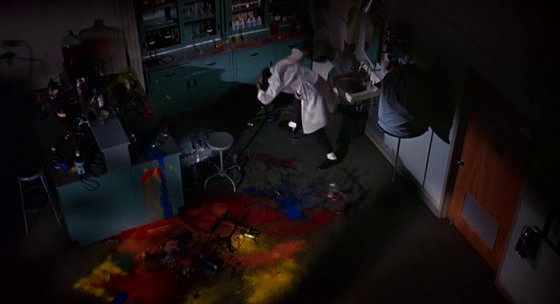
  • The humorously frightening initial “transformation” scene

Must See?
Yes, as Lewis’s acknowledged cult classic — and a rare Lewis film guaranteed to appeal to most viewers, regardless of their tolerance for Lewis.

Categories

  • Cult Movie
  • Important Director
  • Noteworthy Performance(s)

(Listed in 1001 Movies You Must See Before You Die)

Links:

One Million Years B.C. (1966)

One Million Years B.C. (1966)

“This is a story of long, long ago — when the world was just beginning.”

Synopsis:
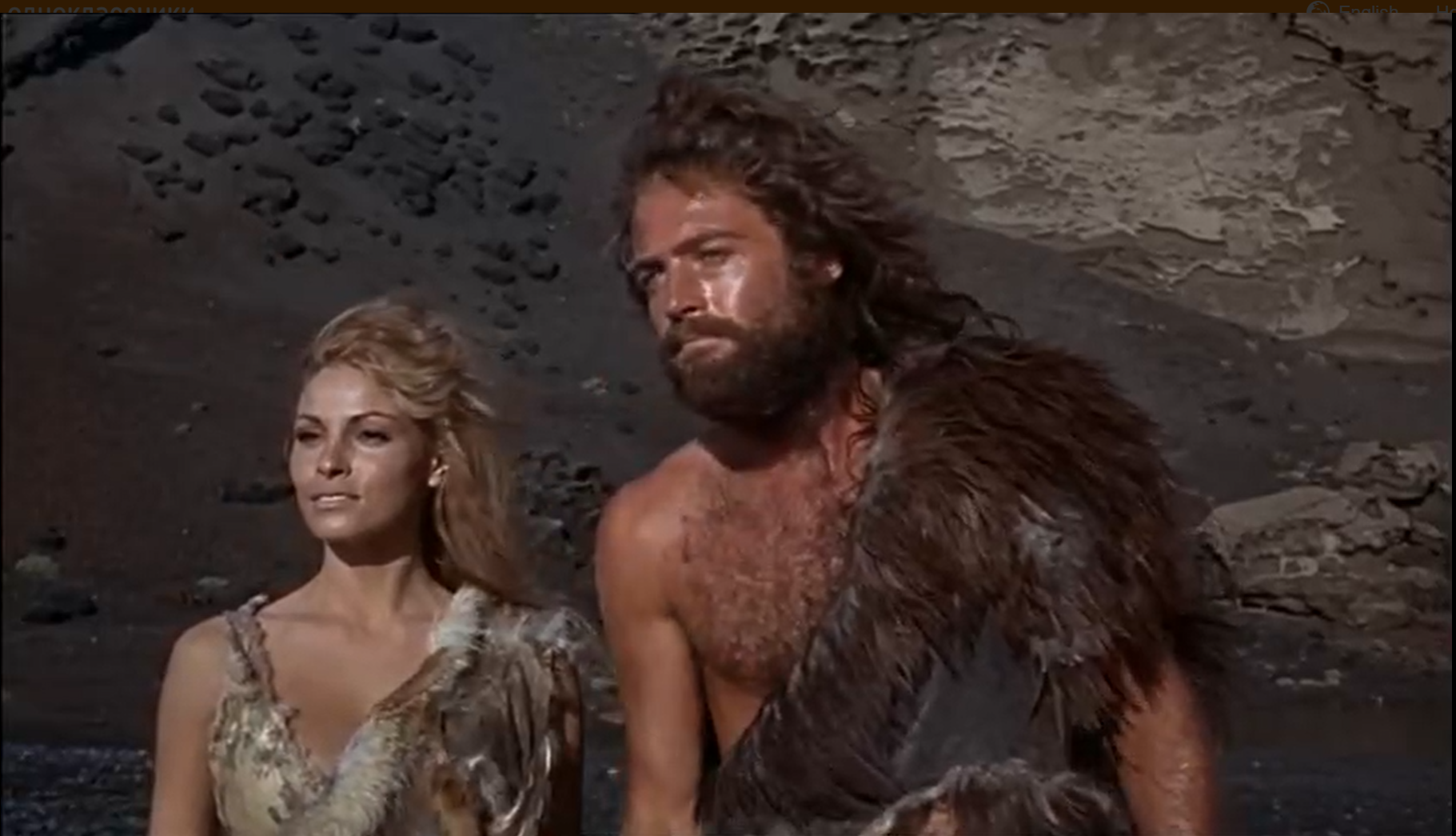
A caveman (John Richardson) banished from his brutal, dark-haired tribe stumbles upon the peaceful, blonde Shell Tribe, where the daughter (Raquel Welch) of the chief falls in love with him after he protects her from a dinosaur attack.

Genres, Themes, Actors, and Directors:

  • Cross-Class Romance
  • Historical Drama
  • Prehistoric Times
  • Raquel Welch Films
  • Ray Harryhausen Films

Response to Peary’s Review:
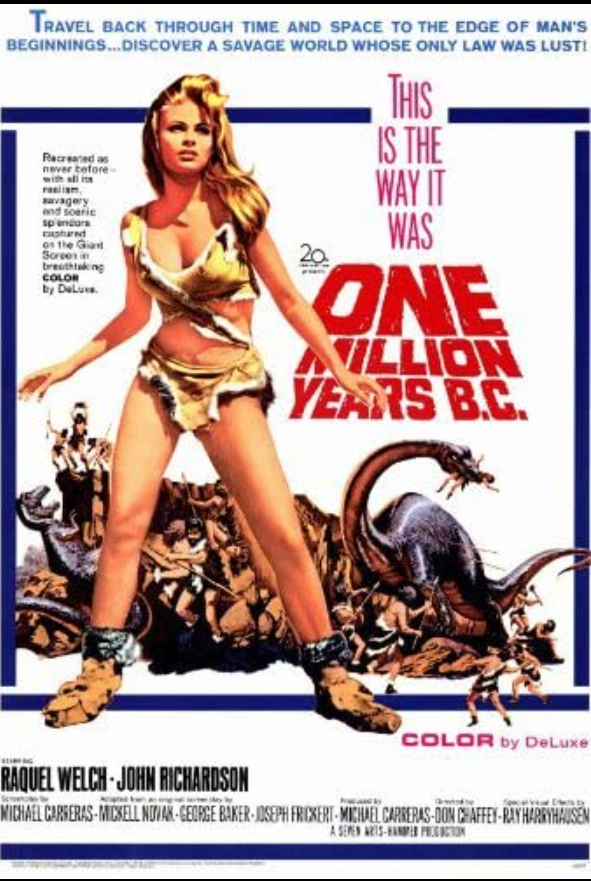
Peary accurately labels this “Hammer Studios remake of Hal Roach’s 1940 film … among the silliest, campiest, and dullest of the ludicrous caveman genre” — noting that “the major appeal” is undoubtedly “the scantily clad Raquel Welch:

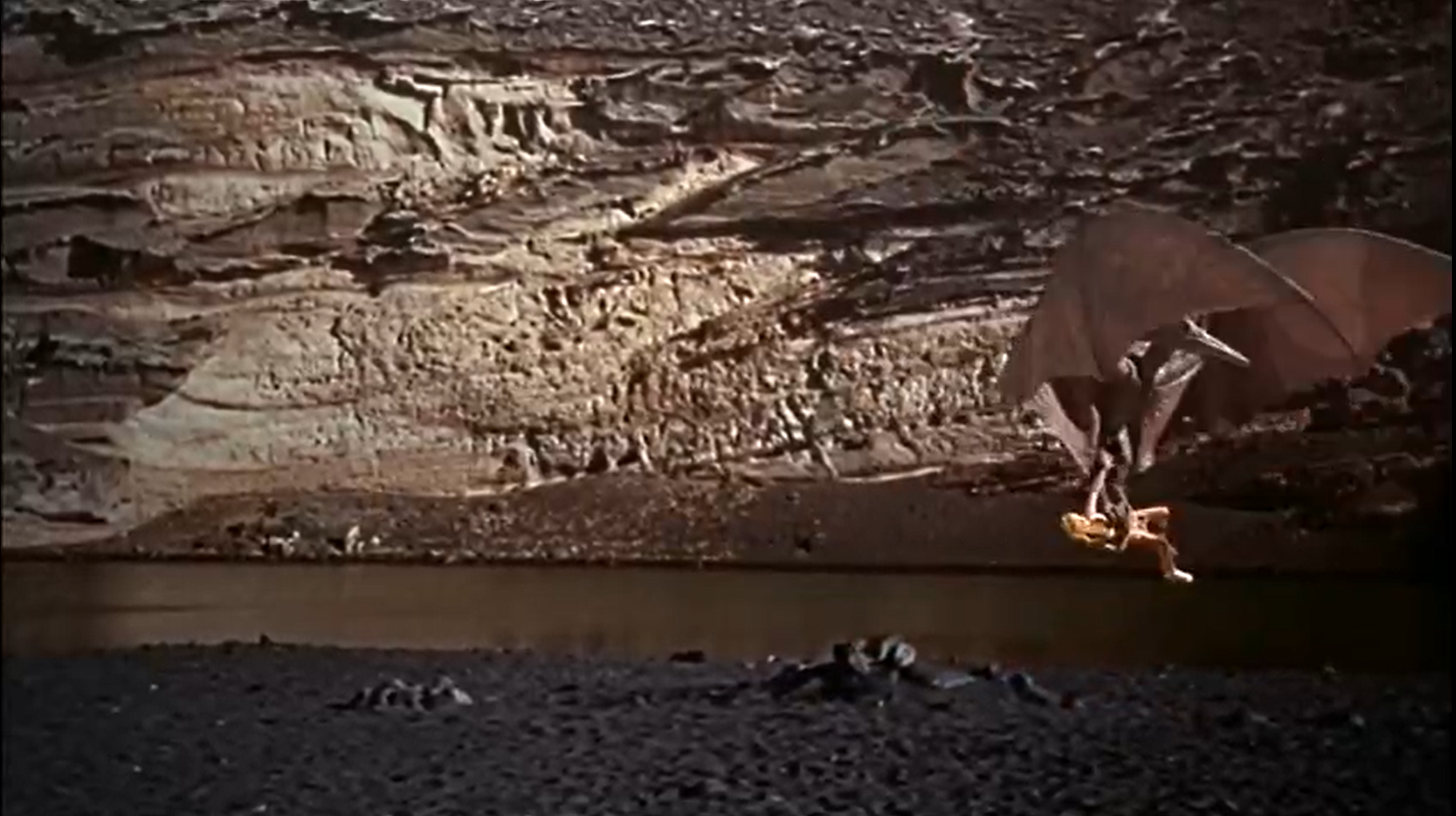
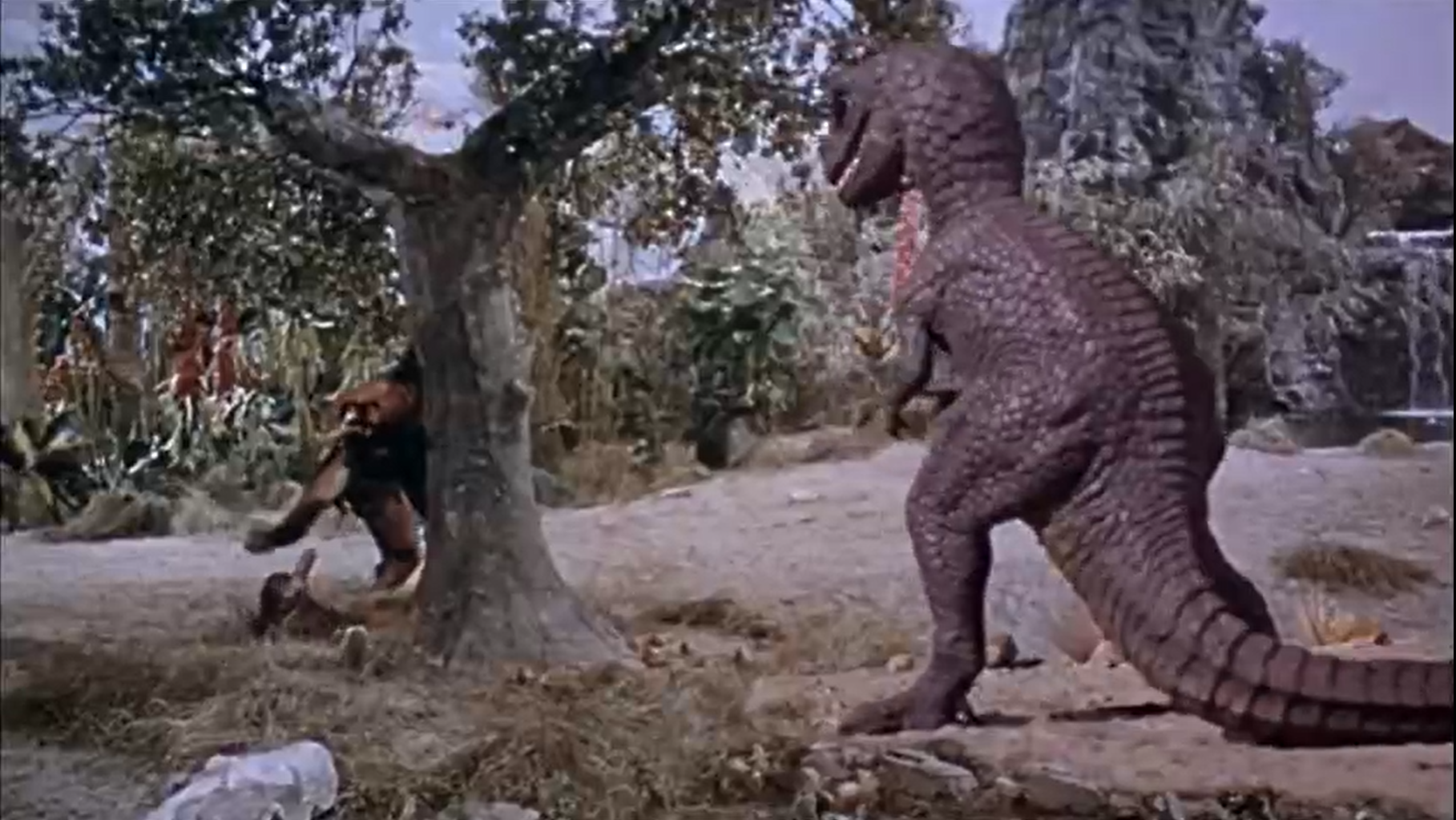
… whose poster from this film adorned the walls of teenage boys worldwide back in 1966″ (and earned revived notoriety when it played an essential role in The Shawshank Redemption). It’s also enjoyed by fans of the great Ray Harryhausen, whose stop-motion animation of several different dinosaurs — including a scene in which Welch is “carried off by a pterodactyl” — remains the film’s primary legitimate selling point (though it unfortunately [?] simply adds to the film’s ridiculous ahistoricity).

It’s astonishing to contemplate the fact that producer Michael Carreras rewrote a script that was “conceived by three writers”, given that there’s no dialogue (other than characters occasionally grunting each other’s names) — what could they possibly have been working on??

Despite its many shortcomings, however, at least this campy remake isn’t quite as deathly dull as its predecessor — though that’s really not meant as an endorsement of any kind.

Redeeming Qualities and Moments:

  • Ray Harryhausen’s stop-motion effects

Must See?
Yes, I suppose so, simply to see the film that launched a (hundred) thousand bedroom posters — but be forewarned that it’s a campy slog.

Categories

  • Historically Relevant

Links:

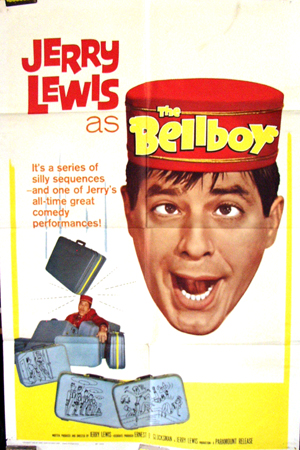
Bellboy, The (1960)

Bellboy, The (1960)

“There’s an awful lot of kooks in this hotel.”

Synopsis:
A mute bellboy (Jerry Lewis) at a fancy hotel encounters and interacts with a variety of guests — including Jerry Lewis himself.

Genres, Themes, Actors, and Directors:

  • Comedy
  • Jerry Lewis Films

Response to Peary’s Review:
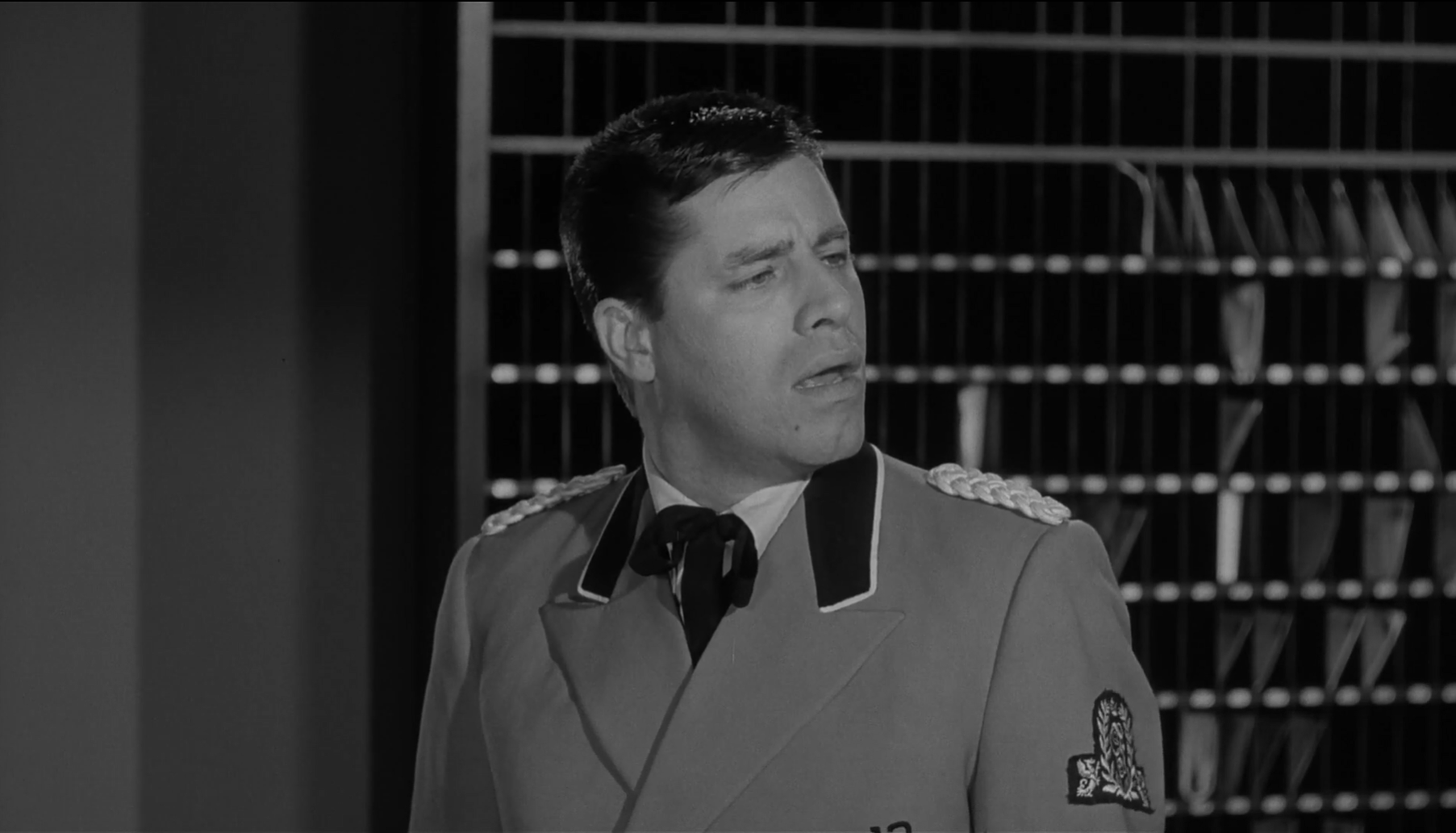
Peary seems only mildly impressed by Jerry Lewis’s directorial debut, “a series of brief, unconnected vignettes” which was “obviously influenced by Jacques Tati’s Mr. Hulot’s Holiday” (1953). He notes simply that while “most gags fall flat” and “none are hilarious”, overall the “film is amusing”. Given that I’m not at all a fan of Tati’s films (and find Mr. Hulot’s Holiday in particular to be quite tiresome), I was genuinely surprised to find myself enjoying The Bellboy as much as I did. While I wasn’t quite laughing out loud (Lewis’s films rarely provoke that reaction in me), I did genuinely chuckle numerous times — and even the gags that “fell flat” seemed to do so innocuously, and with good, simple grace. I suspect a large part of the film’s enjoyment for me lies in the fact that Lewis’s central character — “happy-go-lucky” bellboy Stanley — doesn’t talk (hallelujah!).

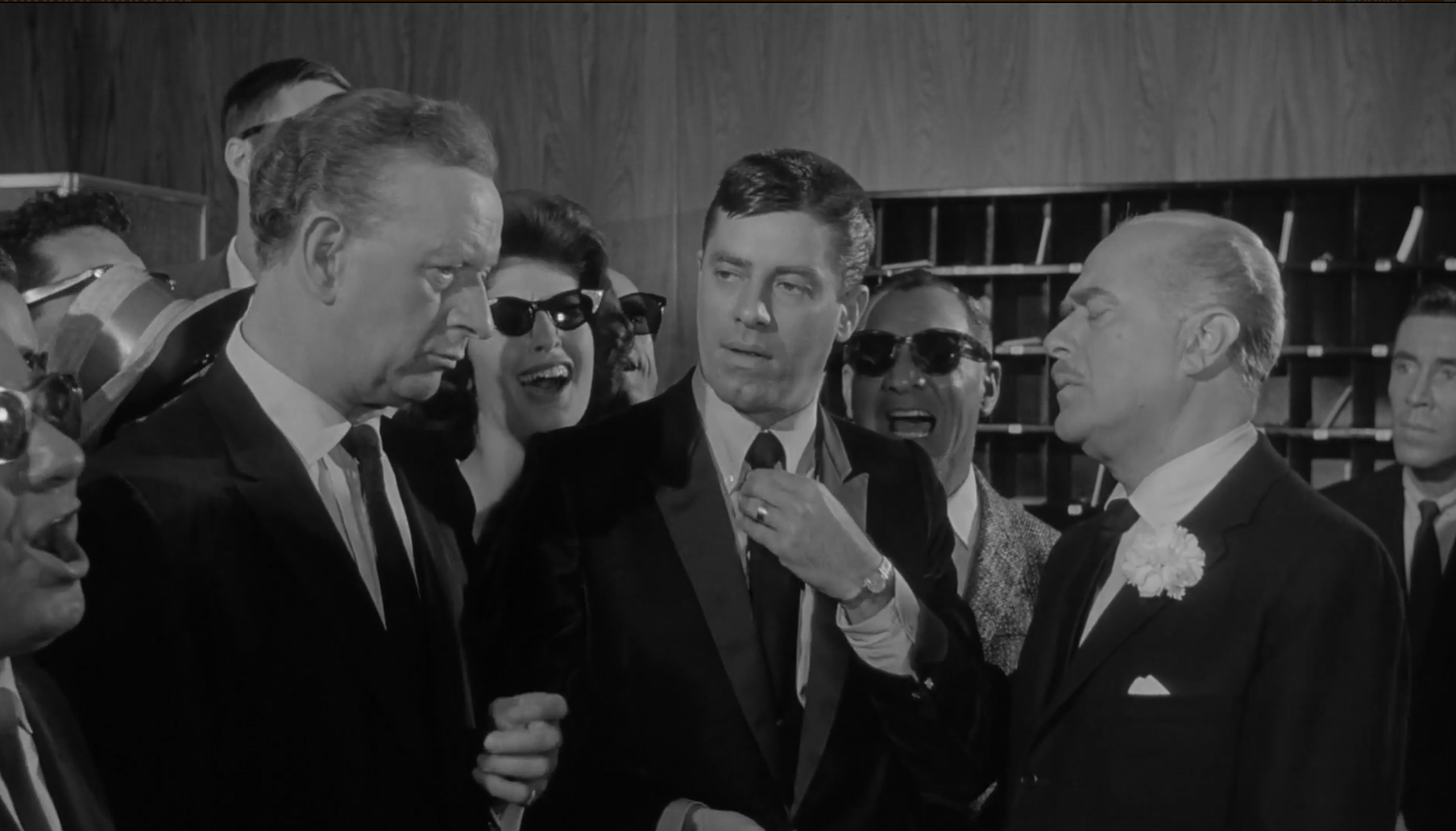
Meanwhile, Lewis pokes some good fun at his own celebrity by appearing in cameo in one of the film’s most genuinely amusing vignettes, as an entourage of assistants clamors around “real” Lewis like a horde of rabid groupies, laughing hysterically each time he opens his mouth to say a word.

(Clearly, Lewis was a tad sensitive about being expected to be “be funny” at all times; this is evident as well in the lengthy and revealing interview he gave with Dick Cavett in 1969 — check YouTube to see this in chunks).

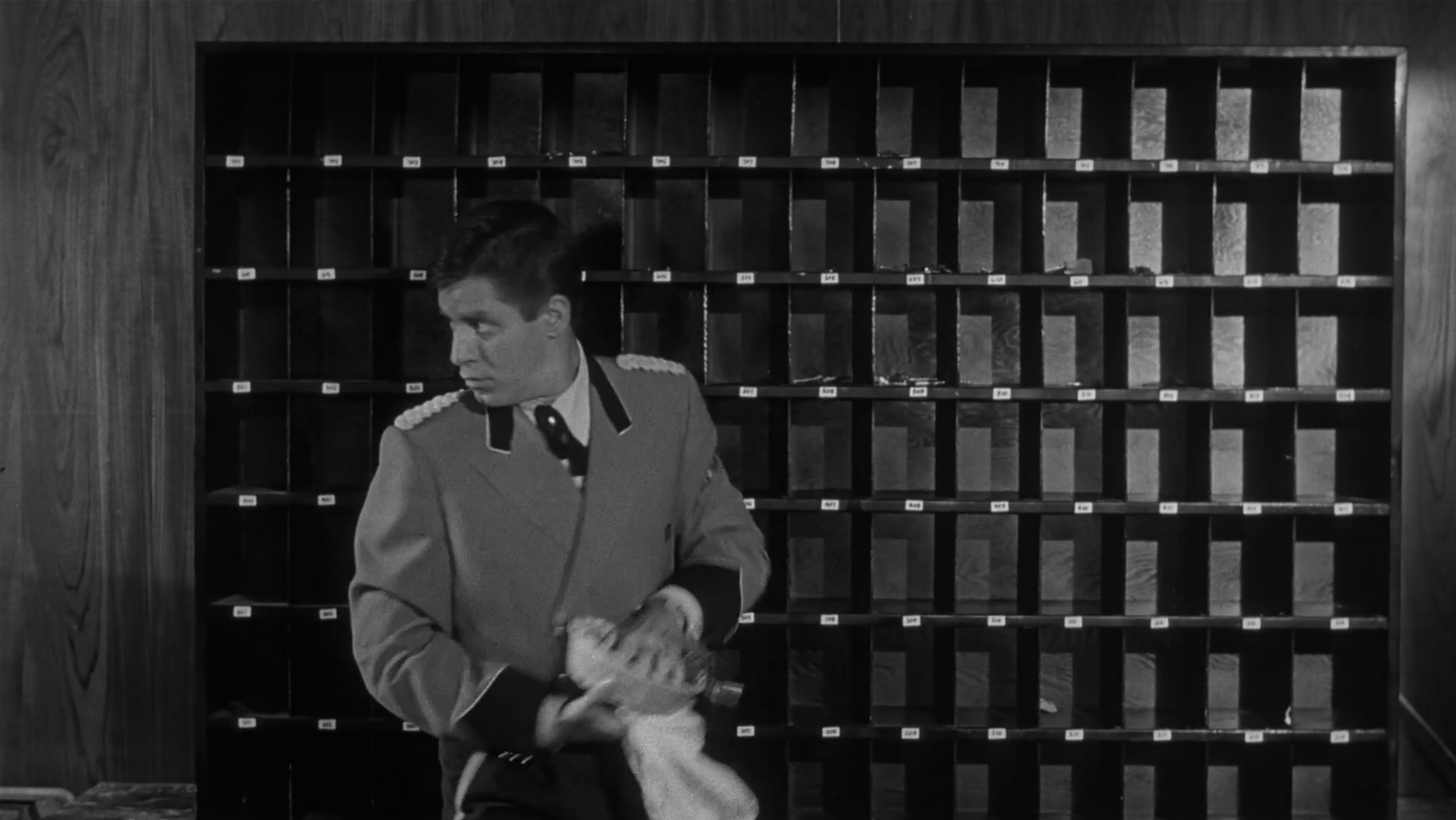
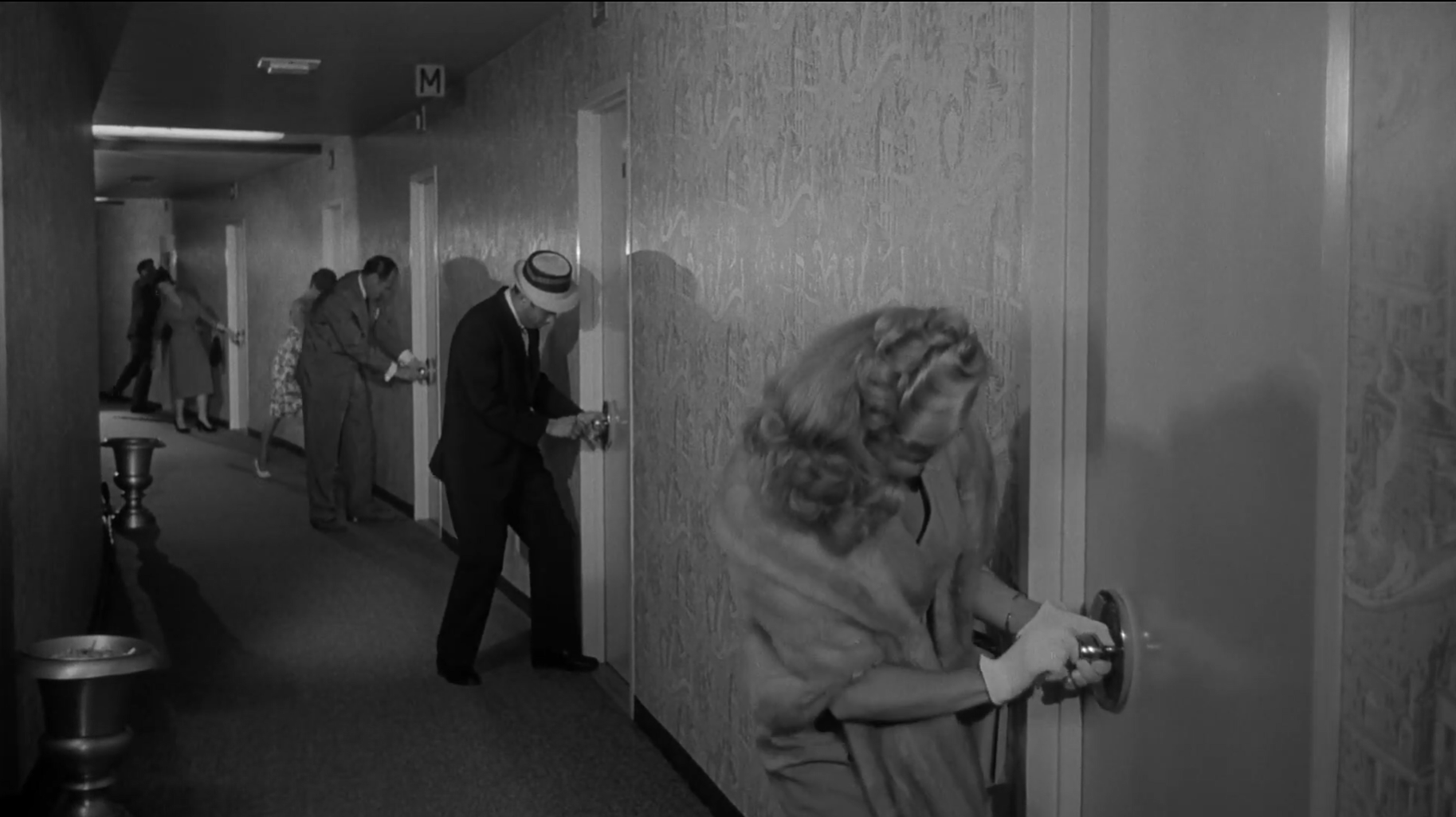
What works about so many of the gags here, I think, is how random and/or surreal they are — and, thankfully, how Lewis rarely lingers too long before moving on. In one of many throwaway scenes, for instance, Stanley is busy sorting keys into guests’ mailboxes, and apparently has been doing such a slow job of it that he’s still not done after an hour. He’s yelled at to finish, and hastily throws the remaining keys willy-nilly into the boxes.

The next shot immediately shows a hallway full of guests wrangling simultaneously with their doors, none having been given the correct key. It’s amusing simply because it defies all rationality — that is, the guests would never all be trying at the same time to open their doors.

Interestingly, in his review, Peary complains about this very fact, noting that “in subsequent films Lewis would learn that his character works best in an otherwise orderly world; here the world he inhabits would be wacky without him”. I disagree. It’s the very “wackiness” of the Fontainebleau Hotel and its inhabitants, I feel, that works in this film’s favor. Just check out the reaction of the entire crew of bellboys when a convention of models walks into the hotel, and you’ll see exactly what I mean… Stanley is not alone.

Note: Be sure to read TCM’s article on the film to learn more about its interesting production, and Lewis’s ground-breaking technique of videotaping alongside his primary camera to get immediate feedback on his work.

Redeeming Qualities and Moments:

  • Numerous humorous vignettes

Must See?
Yes, simply for its historical importance as Lewis’s directorial debut.

Categories

  • Historically Relevant

Links:

Orphans of the Storm (1921)

Orphans of the Storm (1921)

“Help me find my sister — I will do anything you say.”

Synopsis:
During the French Revolution, orphaned young Henriette (Lillian Gish) and her adopted sister Louise (Dorothy Gish) head to Paris to seek a cure for Louise’s blindness — but as soon as they arrive, Henriette is abducted by a lustful aristocrat (Morgan Wallace), while Louise is kidnapped by an unscrupulous beggarwoman (Lucille La Verne) hoping to make money off of Louise’s ailment.

Genres, Themes, Actors, and Directors:

  • Blindness
  • Cross-Class Romance
  • D.W. Griffith Films
  • French Revolution
  • Historical Drama
  • Kidnapping
  • Lillian Gish Films
  • Mistaken Identities
  • Orphans
  • Play Adaptation
  • Search
  • Siblings
  • Silent Films

Response to Peary’s Review:
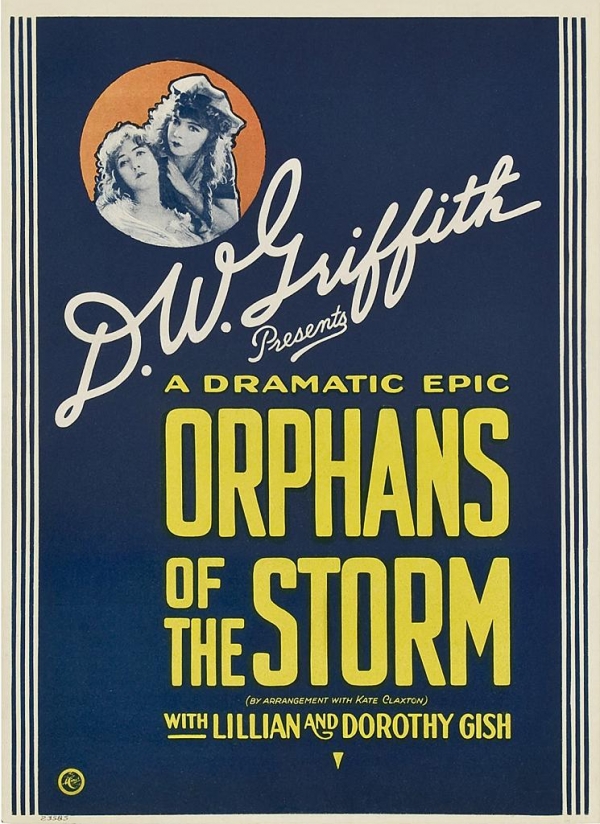
Peary is clearly enamored by this “silent epic” by D.W. Griffith, which he labels “marvelous entertainment, as exciting, old-fashionedly melodramatic, and visually impressive — if not as important — as any of [Griffith’s other] films”. He notes that the movie — a “romantic adventure” which creatively “mixes fiction and historical events” — “never drags because Griffith makes sure that one of the characters we care about is always in deep trouble”; indeed, he literally “milks misery” out of the lead protagonists (the Gish sisters, in their final roles together for Griffith). Peary argues that “beautiful, ethereal [Lillian] Gish was never better than in this film”, with her “close-ups… as impressive as [Griffith’s] spectacular crowd scenes”, and he admits that when Lillian and Dorothy “stand together in the ending two-shot”, he gets “the same feeling as when gazing at a priceless painting”.

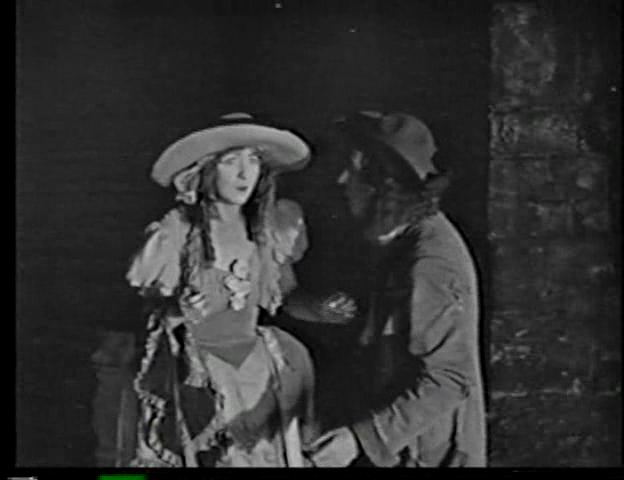
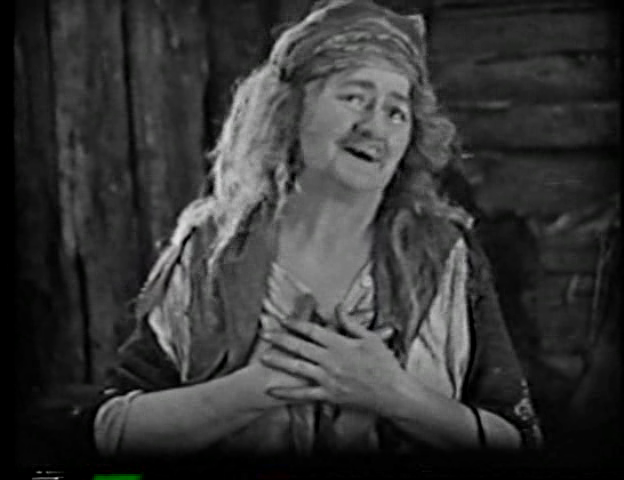
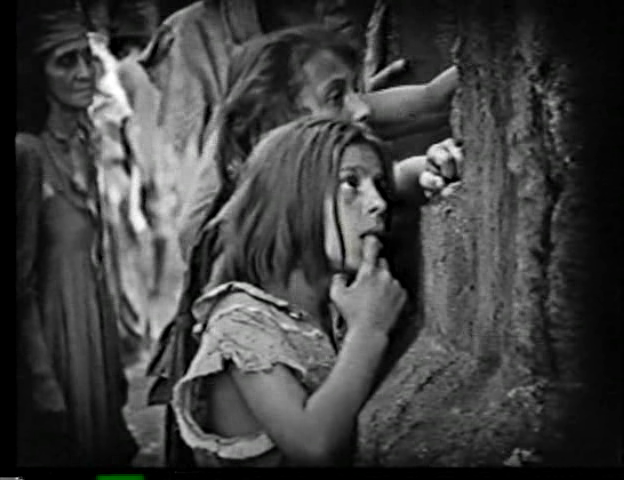
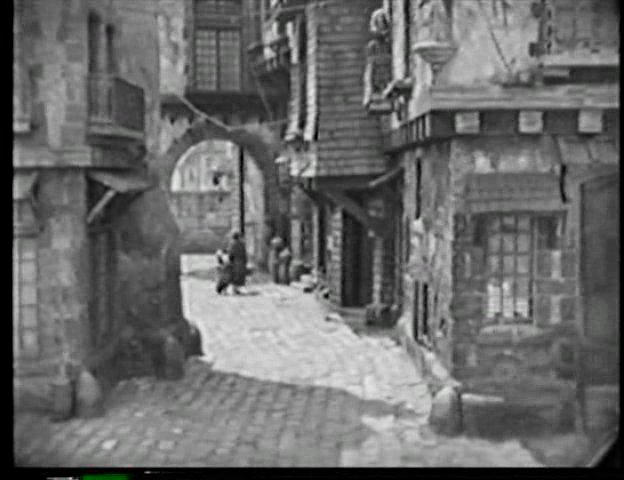
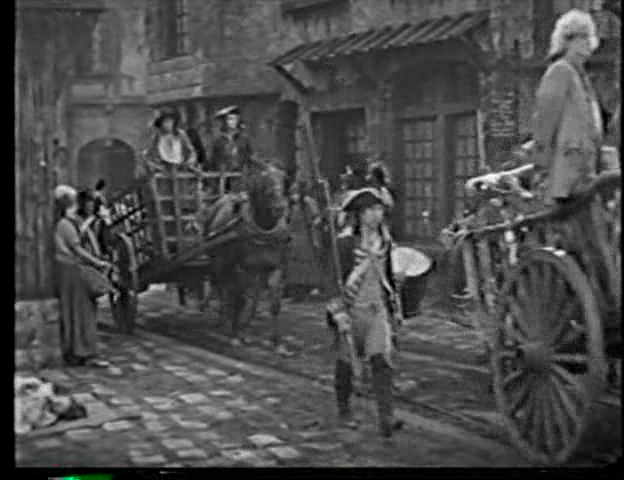
While I don’t find the film quite as personally moving as Peary, I’ll agree with him that it’s a masterful picture which, unlike the vast majority of silent films, stands up remarkably well today — thanks to the critical conflux of ingredients noted above, in addition to fine historical sets and snippets of surprisingly effective realism (see stills below). Lillian (as Henriette) is memorably nuanced in the lead role, and her relationship with her adopted sister thankfully comes across as genuinely touching rather than cloying. Indeed, their sororal bond remains the glue that holds this admittedly dense narrative brew together, as countless characters and subplots compete for space — including Henriette’s cross-class romance with kind Chevalier de Vaudrey (Joseph Schildkraut); the Countess de Liniere (Katharine Emmet)’s recognition that Louise is her abandoned foundling daughter; Louise’s mistreatment at the hands of evil “Mother” Frochard (Lucielle La Verne, hilariously hideous with her faux mustache); and Henriette’s encounters with various historical figures, including Danton (Monte Blue) and Robespierre (Sidney Herbert). It’s a lot to keep track of — but if you’re in the mood for just this kind of melodrama, you surely won’t be disappointed.

Redeeming Qualities and Moments:

  • Lillian Gish as Henriette
  • Dorothy Gish as Louise
  • Lucille La Verne as “Mother Frochard”
  • Effective historical realism
  • Fine period sets

Must See?
Yes, as Griffith’s final masterpiece. Available for free viewing at the Internet Archive.

Categories

  • Important Director

(Listed in 1001 Movies You Must See Before You Die)

Links: