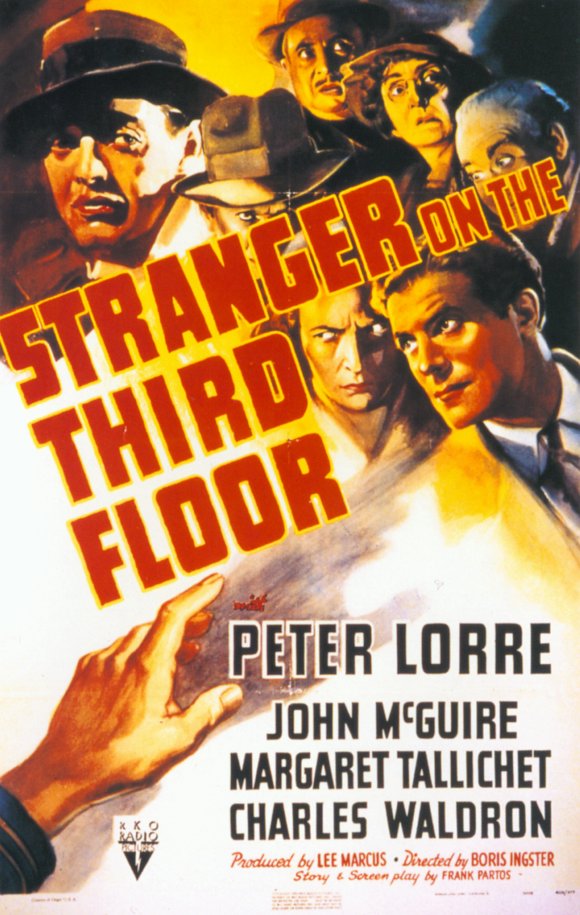
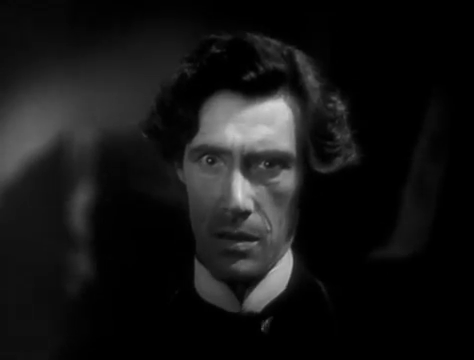
Stranger on the Third Floor (1940)
“I’m not guilty — the stranger killed him!”
|
Synopsis: |
|
Genres, Themes, Actors, and Directors:
Review: Redeeming Qualities and Moments:
Must See? Categories
Links: |
“I’m not guilty — the stranger killed him!”
|
Synopsis: |
|
Genres, Themes, Actors, and Directors:
Review: Redeeming Qualities and Moments:
Must See? Categories
Links: |
“Never go back; always go forward!”
|
Synopsis: |
|
Genres, Themes, Actors, and Directors:
Response to Peary’s Review:
Because producer “Sam Goldwyn wouldn’t let Wyler film on location”, we “don’t get a sense of the grit, grime, claustrophobia, and heat of the slums” — but Peary argues that “the clean studio sets with their painted backdrops act much like a Brechtian alienation device that forces us to realize that this story isn’t self-contained but rather is representative of many tragic real-life stories of the urban poor”.
These days, Dead End comes across as an undeniably stage-bound but still compelling drama featuring fine cinematography and potent direction: each scene is expertly crafted, with dramatic black-and-white shadows metaphorically highlighting the abject distance between the river-bound slum and the wealthy tenants who literally look down on its residents. Bogart is well-cast in a role he first inhabited on Broadway:
and Sidney is appropriately doe-eyed yet stoic:
But the best performance is by Oscar-nominated Claire Trevor, who only appears onscreen for about five minutes yet packs a quietly devastating wallop. Redeeming Qualities and Moments:
Must See? Categories
Links: |
“Someone keeps calling — with a message for my father.”
|
Synopsis: |
|
Genres, Themes, Actors, and Directors:
Review:
and for offering a gory alternative to the sanitized cheer of holiday films like White Christmas (1954). The storyline is somewhat convoluted, but that’s beside the point: what’s really on display here is plenty of atmospheric mystery and suspense in the midst of bloody murders, all as snow falls gently outside in a small east coast town with a heavy history (it was filmed in Oyster Bay, Long Island).
Redeeming Qualities and Moments:
Must See? Links: |
“You realize what you’re implying? That we owe our human condition here to the intervention of insects?”
|
Synopsis: |
|
Genres, Themes, Actors, and Directors:
Response to Peary’s Review: Redeeming Qualities and Moments:
Must See? Links: |
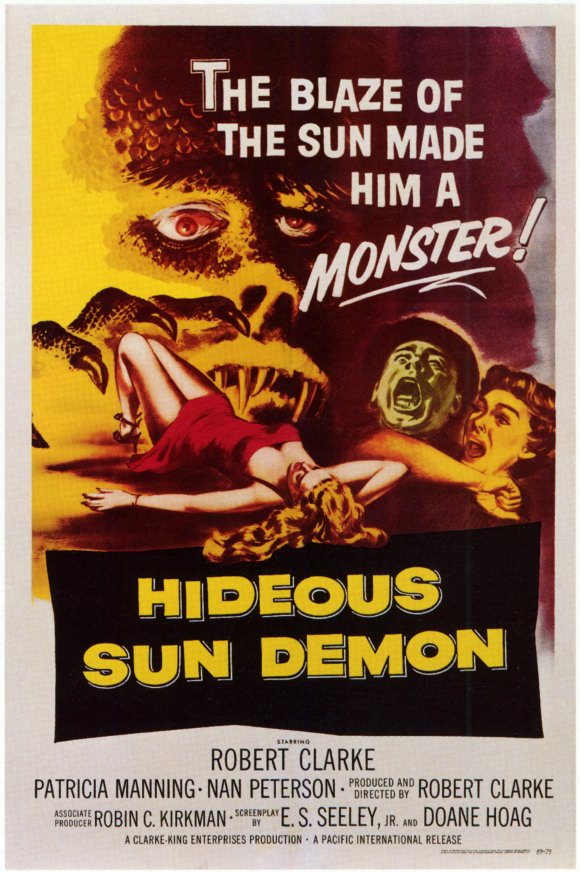
“You mean a human being could evolve backwards in time to become some sort of prehistoric creature?”
|
Synopsis: |
|
Genres, Themes, Actors, and Directors:
Review:
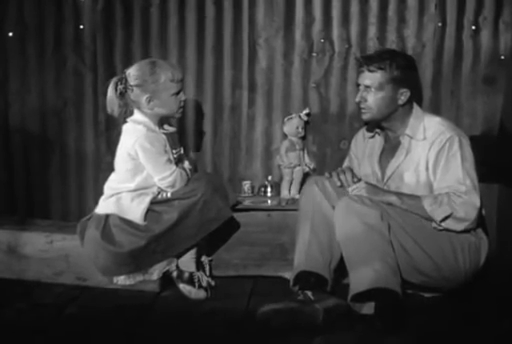
… and the central premise is laughably simplistic. Clues that we’re watching a sub-par production first emerge when we hear characters discussing how Clarke became exposed to radiation; their description is quite vivid, and we wish we could actually see all this taking place! Reasonably memorable elements include Clarke dallying on the beach with a Marilyn Monroe look-alike (Nan Peterson), and interacting with a young girl (Xandra Conkling — how’s that for a name?) whose mother allows her to slip outside to play after a warning has just been announced on the radio:
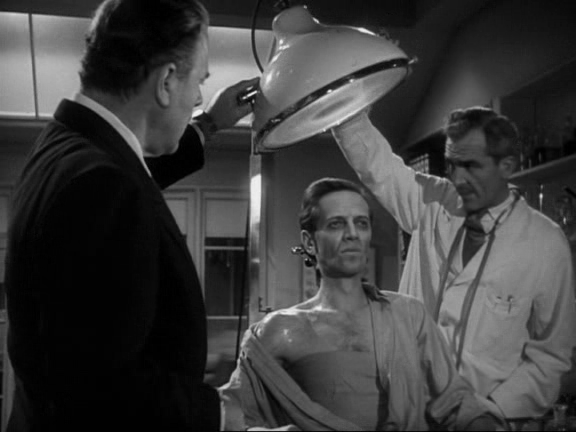
It’s yet another homage to the famous scene in Frankenstein (1931), also referenced in The Creeping Unknown (1955). Check out Wikipedia’s entry for more information about this flick’s production, reception, and comedic re-dubbing in 1983. Redeeming Qualities and Moments:
Must See? Links: |
“It’s almost beyond human understanding: some fantastic invisible force converted two men into… jelly?”
|
Synopsis: |
|
Genres, Themes, Actors, and Directors:
Review: Also driving the film is a true sense of urgency and mystery: what exactly happened to the astronauts, and how much of a danger does Wordsworth now pose? The ultimate findings are reminiscent of modern-day fears over widespread biological contagion (viz. Soderbergh’s Contagion, 2011), as well as ongoing concerns with full-scale invasion by “alien” forces on multiple fronts. Fans have quibbled over the casting of American Brian Donlevy as Quatermass, who comes across as entirely no-nonsense from beginning to end (in one scene, he brusquely contradicts his own orders just a few minutes after realizing he was wrong); but personally, I find him refreshing and well-cast. If the final scene feels a tad rushed, this actually fits with the story’s overall sense of continuous doom, and sequels were nigh on the horizon. Redeeming Qualities and Moments:
Must See? Categories
Links: |
“Delicacy is the banana peel underneath the feet of truth.”
|
Synopsis: |
|
Genres, Themes, Actors, and Directors:
Response to Peary’s Review:
This one’s worth a one-time look for its risque themes, but ultimately not an enduring classic. Redeeming Qualities and Moments:
Must See? Links: |
“I’m no good, you understand? No good at all.”
|
Synopsis: |
|
Genres, Themes, Actors, and Directors:
Response to Peary’s Review:
Dietrich’s unusual character — a “strong, selfless woman who is willing to sacrifice herself for others’ happiness (even if it means giving her body) and to face the consequences for her sins” — “sees no need to apologize or defend herself to Marshall for what she did on his behalf,” yet also doesn’t “expect him to understand or forgive her”.
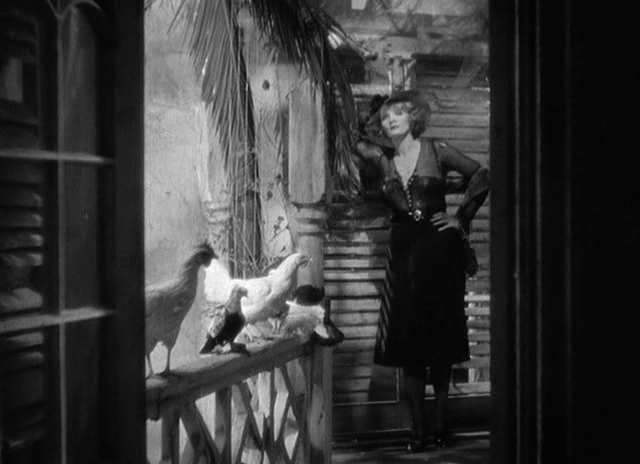
She’s a highly complex woman, and yet a bit of a feminist cipher: we’re not sure why she falls in love with Marshall and comes with him to America, nor why she so easily commits infidelity while her husband may be on his deathbed. Ultimately, the storyline itself — including a “descent into hell” as Dietrich “winds up sleeping in some bizarre dives, including one place in which hens and chickens run free”:
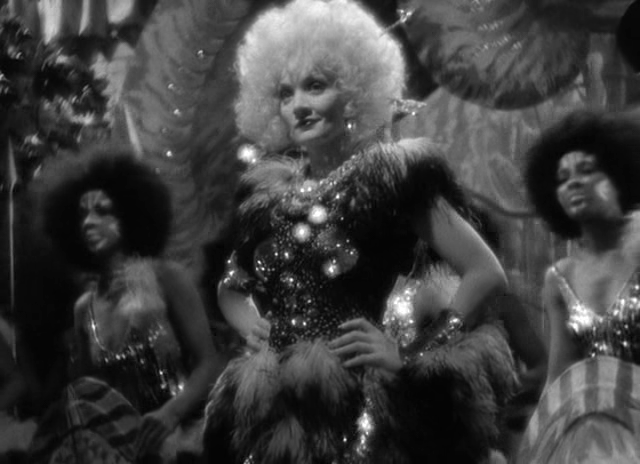
— simply emerges as pure melodrama peppered by two highly memorable nightclub performances, one in which Dietrich dons a blonde frizzy wig as “Blonde Venus” while emerging out of a gorilla suit:
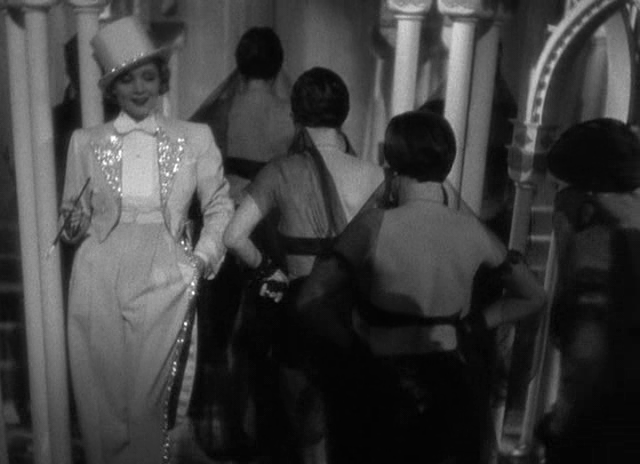
and a later scene in which she famously wears a white top hat and tails while ogling chorus girls.
It’s no wonder this film is a favorite with gay and camp-loving audiences! Redeeming Qualities and Moments:
Must See? Categories
Links: |
“She defiled the image I had created of her — and so, I killed her.”
|
Synopsis: |
|
Genres, Themes, Actors, and Directors:
Response to Peary’s Review:
He notes that it provides John Carradine “his best lead performance and one of the few in which he doesn’t succumb to hamminess”; indeed, in his Alternate Oscars book Peary nominates Carradine as one of the Best Actors of the Year for this role.
While I find the film visually impressive, I’m much less taken with its rather insipid storyline, which doesn’t reveal Bluebeard’s motivations until close to the end, and thus leaves us puzzled about why a seemingly likable puppeteer turns randomly into a murderer whenever he paints a beautiful woman.
It’s nice to see Carradine given a leading role, and he’s suitably nuanced, but I much prefer him in his more memorable supporting roles — like Preacher Casy in The Grapes of Wrath (1940). Redeeming Qualities and Moments:
Must See? Links: |
“Feeeeed me!”
|
Synopsis: |
|
Genres, Themes, Actors, and Directors:
Response to Peary’s Review:
… visits from “a low-keyed flower eater” (Dick Miller) which presumably are intended to “counter the man-eating flower”:
… “Seymour’s visits with his hypochondriac mother (Myrtle Vail)”:
… and each of Seymour’s unintentional killings — er, scavenger hunts for food.
LSOH was eventually made into an off-Broadway musical, which itself was turned into a 1986 film by Frank Oz (listed in the back of Peary’s book). Redeeming Qualities and Moments:
Must See? Categories
Links: |