Judgment at Nuremberg (1961)
“We must forget if we want to go on living.”
|
Synopsis: |
|
Genres, Themes, Actors, and Directors:
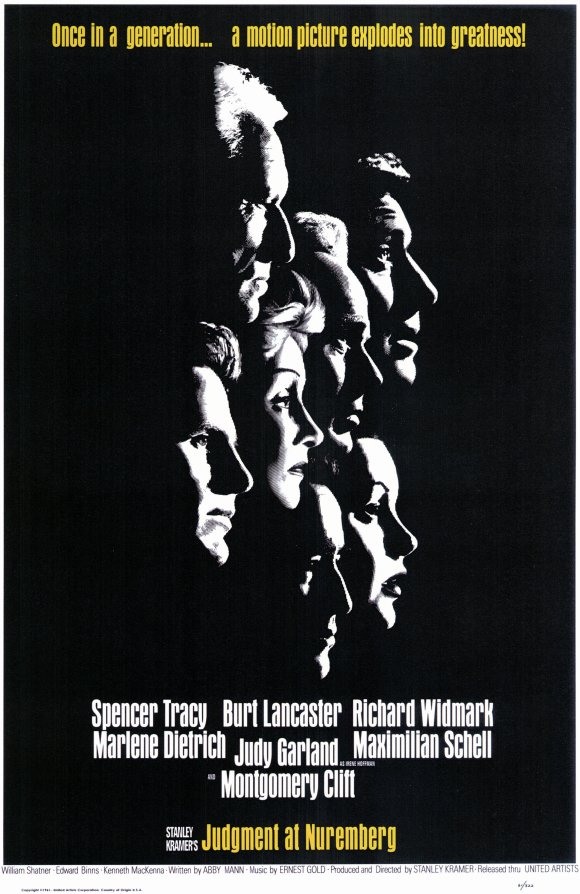
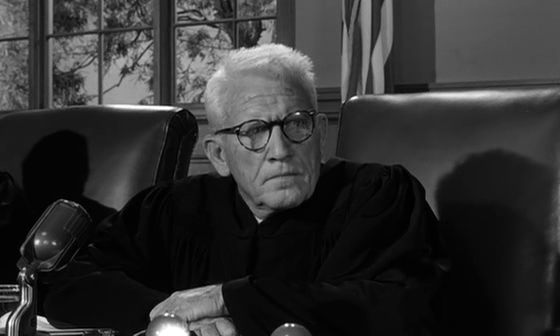
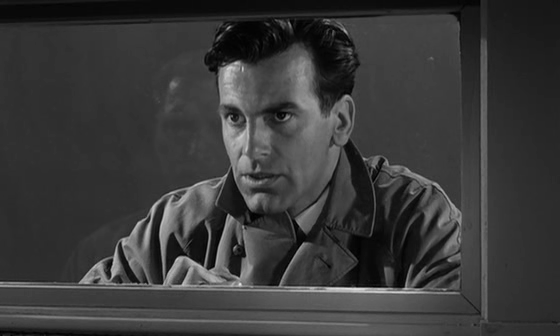
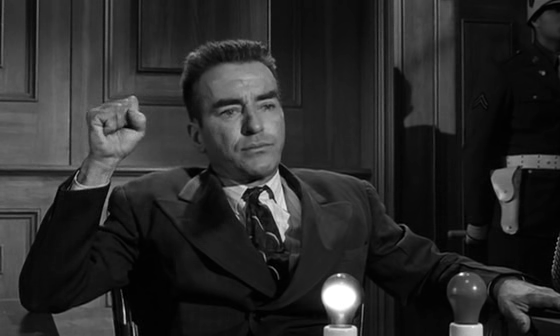
Review: Judgment at Nuremberg, despite its strengths, is a uniquely challenging courtroom drama to sit through, given that we’re not meant to judge whether the sentences received by the two victims who testify in court — a mentally challenged laborer (Montgomery Clift) sterilized for his Communist associations, and a young Aryan woman (Judy Garland) imprisoned for her friendship with an older Jewish gentleman — were just or not; of course they weren’t. What’s actually at stake here is whether the judges on trial were right to sentence these individuals as they did. Interestingly, the broader context of the trials — i.e., the question of whether Americans and others even had a “right” to come in to Germany and prosecute its citizens in such a manner — is only explored through the perspective of the Germans (such as Marlene Dietrich’s widow, Maximillian Schell’s defense attorney, and Burt Lancaster’s judge) who bitterly resist this imposition. Otherwise, the only non-German perspective we get on the matter is when a judge is cautioned to acquit the defendants as a strategic Cold War maneuver, to maintain good relations with the country. Viewers will be left to decide for themselves whether the trials themselves were ultimately warranted or not. The Oscar-nominated performances throughout, naturally, are top-notch, beginning with Tracy’s subtle yet powerful turn in the tricky central role; we empathize with his situation every minute he’s on-screen. Clift is simply phenomenal in a scene-stealing turn as a mentally challenged young man who struggles to articulate his thoughts, yet knows that what was done to him was not right. Garland’s supporting role is less showy, but she’s also impressive — and, as many have noted, her performance here was clear evidence of the type of “serious” role she could have excelled at if her life had taken a different set of personal turns. Richard Widmark is appropriately cast as a righteous prosecutor convinced that the judges must pay for their actions, while Oscar-winner Maximillian Schell (who Peary argues didn’t actually deserve the Best Actor award, given that his role is more of a supporting one) convincingly portrays the pride and indignation felt by occupied Germans after the war. Note: Kramer’s attention to detail throughout the film is rigorous and noteworthy — including the clever way in which he has the actors switch from engaging in simultaneous German/English translation to simply speaking in English, with the implicit acknowledgement that we’re meant to “hear” them as still speaking in their native language. Redeeming Qualities and Moments:
Must See? Categories
Links: |